Trussing Types Explained: Pre-Rig, Flown, and Ground-Supported
Three truss approaches solve different problems. Here's how to pick the right structure for your room, load-in, and focus time.
You walk into the room, look up, and the ceiling tells you what kind of day you’re going to have. If you’ve got clean rig points, reasonable trim, and a venue crew that knows the drill, flown truss can make the show feel effortless. If the ceiling is a patchwork of unknowns, or your schedule is tight, a pre-rig package can keep you moving. And when the building won’t fly anything at all, ground-supported truss becomes the backbone that lets you hang lights, audio, LED, and soft goods safely.
Below is how we think about the three big trussing approaches — pre-rig, flown, and ground-supported — from a producer’s point of view. The goal isn’t to make you a rigger. It’s to help you choose a structure that fits your room, your content, your load-in window, and the way you need to run the show.
start with what you’re trying to hang (and where)
The fastest way to get truss wrong is to pick a structure before you’ve listed the loads and the placement. A ballroom grid for wash lights and a couple of projectors is one thing. A U-shaped IMAG truss with multiple cameras, a flown LED header, and scenic elements is another.
We start every truss conversation by answering three questions:
- What are the heaviest objects, and do they need to move (motors) or stay static (dead-hang)
- Where do those objects need to live for the audience sightlines and camera frames
- How much flexibility do we need once we’re in the room
Those answers steer you toward the right approach because each truss type trades off speed, flexibility, ceiling dependency, and footprint.
pre-rig truss: speed and consistency when time is the enemy
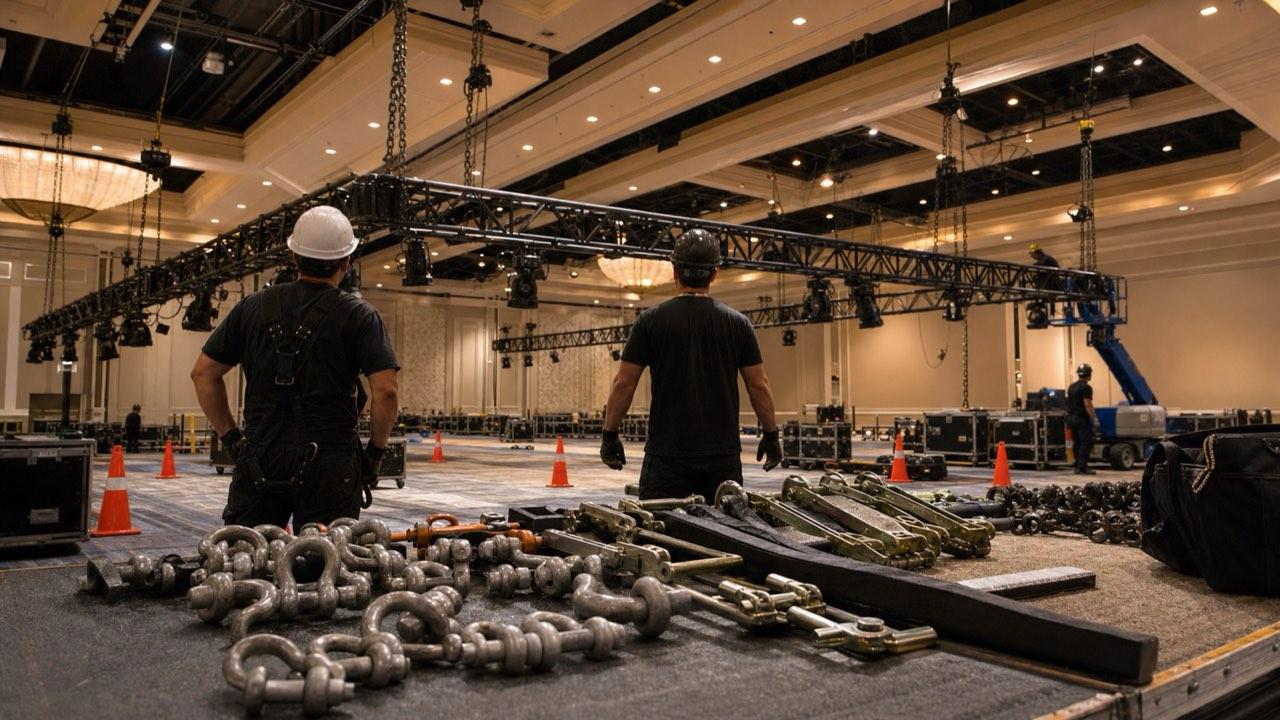
Pre-rig (pre-rigged) truss is truss that arrives with fixtures already installed, cabled, and often addressed. Think of it as modular “lighting battens” (or video battens) that you can motor up, tidy, and repeat. Pre-rig isn’t a magic shortcut — you still need safe rigging and careful planning — but it can compress a long day into a manageable one.
where pre-rig shines
Pre-rig tends to win when you have:
- A tight load-in with limited overnight access
- A repeatable look across multiple rooms or multiple show days
- A lot of fixtures that would otherwise take hours to mount and cable
- A crew that needs predictable tasks and fewer one-off decisions
In practical terms, pre-rig is how we keep corporate general sessions moving when doors are fixed, rehearsals are non-negotiable, and the room has a hard stop.
what pre-rig costs you
Pre-rig truss is heavier and bulkier than bare truss, and that ripples through the whole plan.
- Rigging loads increase because you’re lifting truss plus fixtures plus cable management hardware
- Truck pack gets harder because the modules have to be protected and staged in a specific order
- On-site flexibility drops because fixtures are already “where they are,” unless you planned spare positions
If you want to move key lights later because a scenic piece grew, pre-rig can fight you. We can build in spare capacity and alternate pick points, but it needs to be intentional.
flown truss: clean floor, clean sightlines, and maximum flexibility
Flown truss is the classic: truss is built (or flown as sections), picked from rig points, trimmed to height, and used as the overhead structure for lighting, audio, LED, and drape. When the ceiling and venue policies support it, flown truss is often the most elegant solution.
why producers like flown truss
Flown systems keep the floor open. That matters more than people think.
- Better audience flow and fewer trip hazards
- Cleaner camera moves and fewer obstructions for jib and handheld
- More usable backstage and storage space because towers aren’t eating square footage
Flown truss also plays nicely with late changes. Need to move a downstage truss six feet because the set changed? It’s a rigging change, not a carpentry rebuild.
the ceiling is the boss
The downside is obvious: flown truss is only as good as the venue’s rigging infrastructure and documentation.
Before you assume you can fly, we want:
- Rigging plot or point list from the venue
- Maximum allowable loads per point (and any distributed load rules)
- Confirmed trim heights and any hard limits (chandeliers, HVAC, sprinkler clearances)
- A plan for how motors will be controlled and who operates them
If any of that is missing, you can still fly, but you’re trading certainty for risk. That’s fine on some shows. On others, it’s how you burn half a day waiting for answers.
ground-supported truss: when you can’t fly, or when you shouldn’t
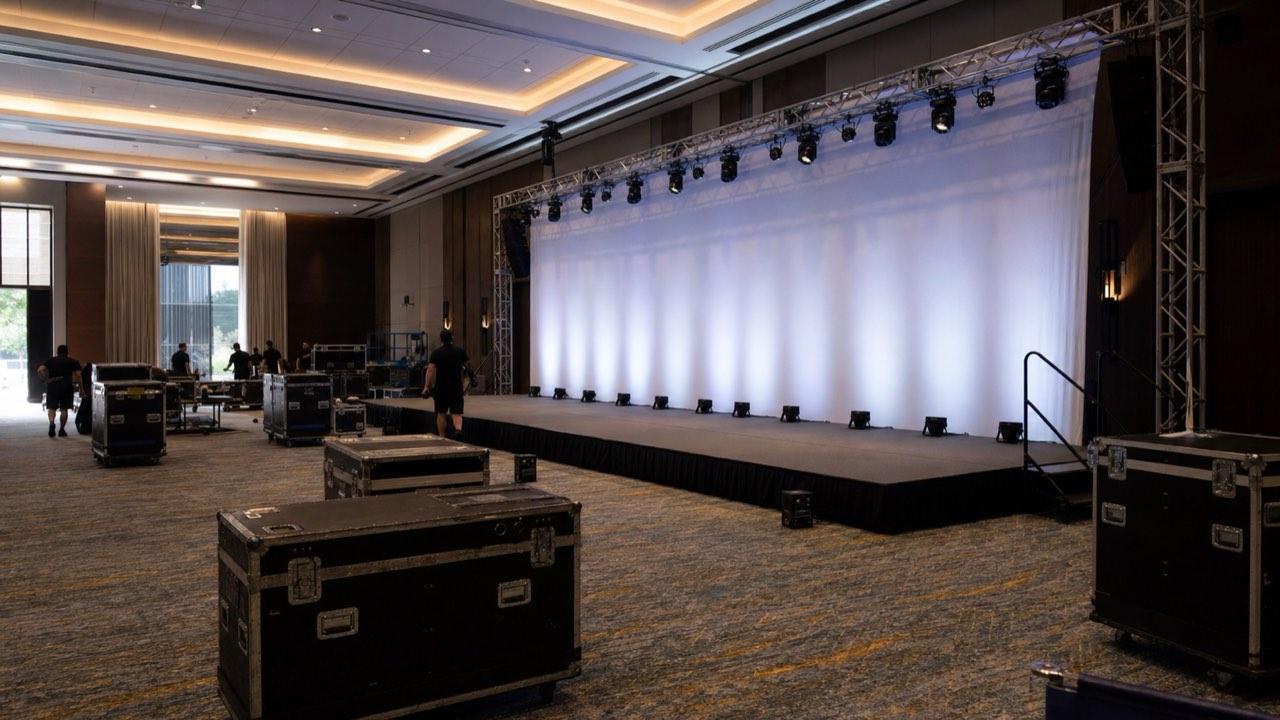
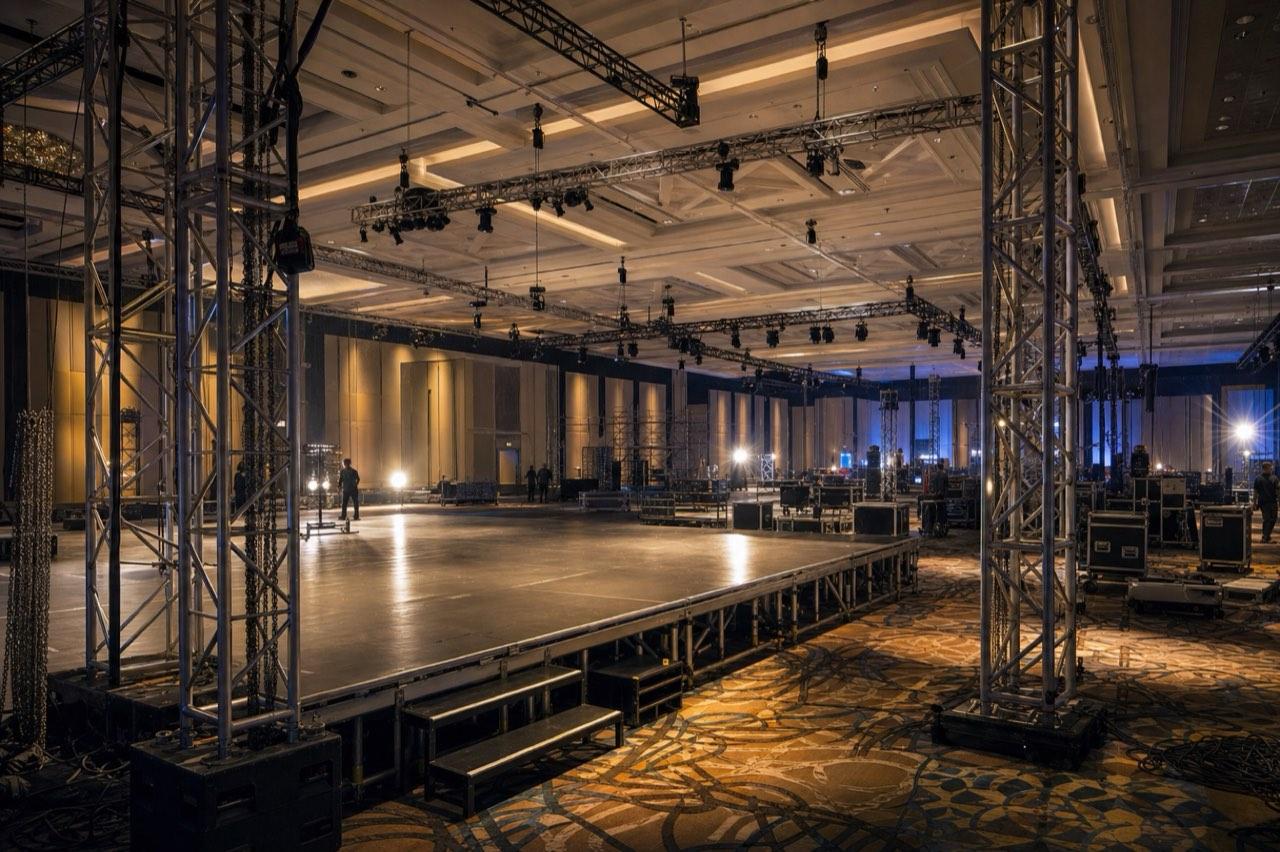
Ground-supported truss is your “build it from the floor” option. It can be as simple as two goalposts with a span, or as complex as a full grid on towers with multiple spans and cross-members.
This is the structure you lean on when:
- The venue won’t allow overhead rigging
- The ceiling is too low or too busy
- Rig points exist, but the math and the schedule don’t work
- You need a structure outside (where flying is rarely an option)
the big trade: footprint for independence
Ground-supported systems buy you independence from the building. You’re not waiting for points, you’re not negotiating every pick, and you can engineer the structure around your stage picture.
But you pay for that independence with floor space and sightlines. Towers have bases, ballast, and guying considerations. In a tight ballroom, that can collide with seating, aisles, and camera lanes.
stability isn’t a vibe, it’s a plan
Ground-supported truss must be designed for the loads and the environment. Wind matters outdoors. Cable management matters everywhere. So does the “what happens if someone climbs this” factor.
When we build ground-supported, we treat it like a structure, not like oversized pipe and drape. That means:
- Known load paths (what load is going where)
- Proper base sizing and ballast where required
- Correct bracing and connection hardware
- A real plan for how things get built safely during load-in
choosing between the three: the producer decision tree
Most shows don’t start with “what truss do you want.” They start with constraints.
constraint 1: venue policy and rigging access
If the venue doesn’t allow flying, your choice is made: ground-supported or a hybrid that uses limited approved points.
If the venue allows flying but requires union labor or a house rigging provider, that’s not a deal breaker — it’s a scheduling and coordination item. The real producer question becomes: will the rigging window and labor rules fit the show timeline.
constraint 2: load-in window and staffing
Pre-rig is a time-management tool. If you have one day to load in a full general session, pre-rig can keep the crew focused on assembly rather than repetitive fixture work.
Flown truss can be fast too, but only when you’re not waiting on point verification, lift access, or approvals.
Ground-supported is predictable, but it’s physically intensive and can compete with stage and scenic teams for floor space.
constraint 3: stage picture and camera plan
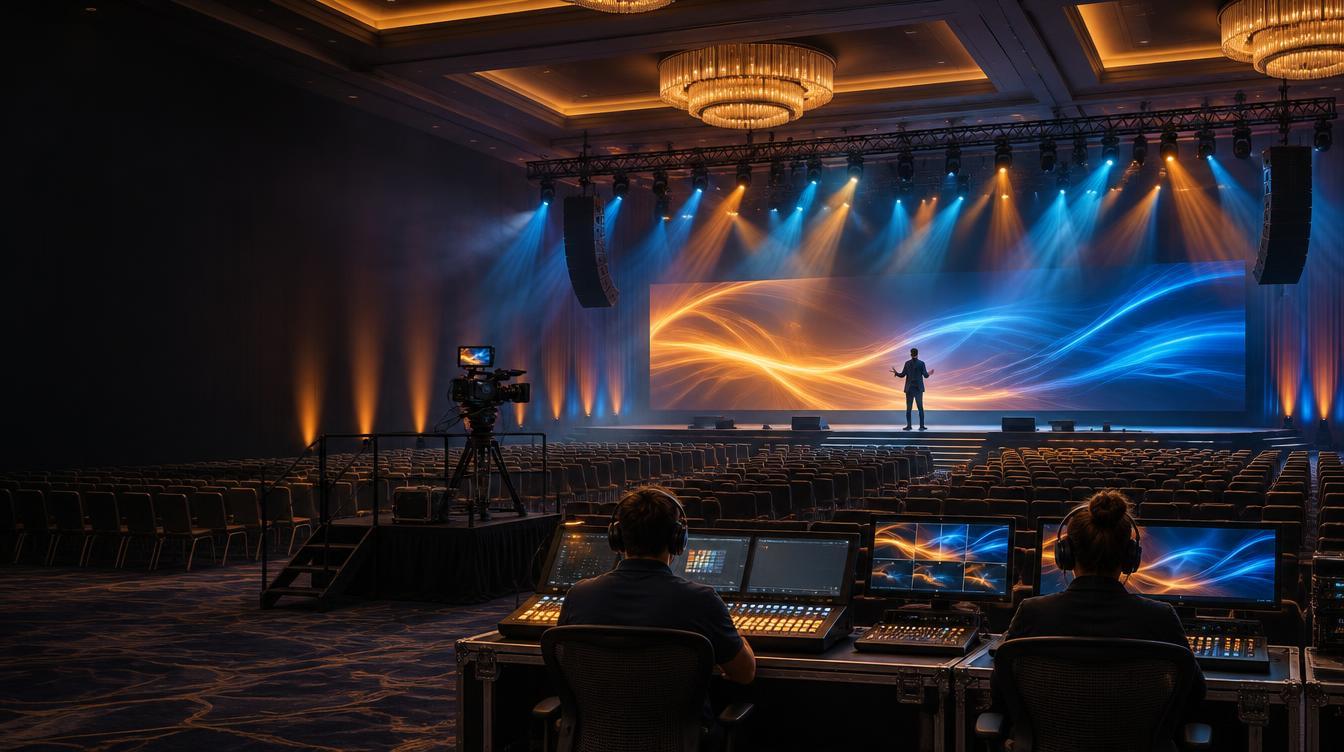
If you’re shooting IMAG, recording ISO, or doing a broadcast-style stream, your truss choices are really camera choices.
- Towers that block a long lens shot are a problem
- A downstage goalpost that forces cameras wide can change how your show feels
- Low trim heights can force fixture choices (and reduce punch) in ways that matter on camera
We like to lock camera positions early, then build the structure around them.
trim height: the hidden variable that changes everything
Trim height is the vertical distance from the floor to your truss. In ballrooms, trim is often constrained by ceiling height, sprinklers, chandeliers, and air walls. A two-foot change in trim can decide whether the stage feels cinematic or flat.
- Higher trim gives you better beam angles and cleaner looks
- Lower trim can still work, but it pushes you toward softer, wider fixtures and more careful focus
Pre-rig can sometimes help here because you can build a clean module at a known depth and keep the cabling tight, which reduces the “we need extra headroom for mess” problem.
point loads and distributed loads: what producers should actually care about
You don’t need to run the calculations, but you do need to know what questions to ask.
Point load is the weight on a single rigging point. Distributed load is weight spread across multiple points or across the truss itself.
The producer translation is:
- Heavy objects (like motors, big speakers, or LED headers) concentrate load
- Evenly spaced lighting fixtures are friendlier to the structure
- “We’ll just add one more thing” can be fine, or it can push a point over its limit
If your show has late additions, build spare capacity into the design. It’s cheaper than a last-minute re-rig.
hybrid approaches: the real-world answer more often than not
Many corporate rooms end up hybrid.
Examples we deploy a lot:
- Flown upstage truss for key light and scenic wash, ground-supported downstage for specials and presenter light
- Pre-rigged flown truss for the main grid, with a small ground-supported goalpost for an LED header where points are limited
- Ground-supported grid with a few approved dead-hangs for PA or special scenic elements
Hybrid builds let you use the ceiling where it’s helpful and stay independent where it’s not.
build order and room flow: don’t let truss block your own load-in
A common failure mode is building truss in the same footprint you need for cases, lifts, and stage decks. Even a well-designed system can become a traffic jam.
We plan build order like this:
- Mark tower bases, stage edge, and any keep-out zones first
- Stage and scenic get their primary footprint built early
- Truss goes up next, before you fill the room with cable and cases
- Then lighting focus and cable dressing, followed by audio tune and video line checks
The structure should enable the work, not compete with it.
cabling and power: the difference between “up” and “show-ready"
Getting truss in the air is not the end of the job. The end is a system that can be operated, serviced, and reset during rehearsal.
For lighting control networks and power runs, we like:
- Clear cable paths that keep weight where the structure expects it
- Service loops where fixtures might be swapped
- Power distribution that doesn’t strand you without circuits on a key span
If you’re running data (Art-Net or sACN) and video transport, keep it organized and label aggressively. It’s the only way to troubleshoot under time pressure.
safety and approvals: keep it boring
The safest truss day is the boring truss day. That starts with paperwork and ends with walking the build.
We look for:
- A rigging plot that matches what’s in the air
- Motors and controllers that are inspected and operated by qualified crew
- Proper secondary safeties where required
- Barricades or keep-out zones while lifts and motors are moving
If something feels improvised, pause. The time you “save” rarely survives the first problem.
what to send your production vendor so the quote is accurate
If you want a quote that doesn’t come back full of caveats, send information that reduces unknowns.
At minimum, we want:
- Venue name, room name, and show dates
- Stage size and approximate seating plan
- A rough input list: lights, audio hangs, LED elements, scenic pieces that need to attach
- Any venue rigging documents you already have
- Your target load-in window and rehearsal start time
When we know what you’re hanging and what the room allows, we can propose the simplest structure that gets you the look.
the practical takeaway
Pre-rig is about speed and repeatability. Flown truss is about a clean room and flexible overhead structure. Ground-supported is about independence when the building can’t (or shouldn’t) carry the load.
If you’re deciding between two options, choose the one that reduces uncertainty for your schedule. A slightly larger structure that you can build predictably is often cheaper than a smaller one that turns into a rigging negotiation on site.
If you want EventProSource to spec the truss plan and rigging approach for your room, we can build a plan that covers the structure, load assumptions, and a load-in sequence your crew can actually execute. Email hello@eventprosource.com for a 24-hour quote and a practical recommendation based on your run of show.