Outdoor Staging in the Northeast: Weather Planning Guide
Outdoor stages survive bad weather when the planning happened weeks in advance. Here is the decision framework we run on every Northeast outdoor build.
The Northeast weather problem
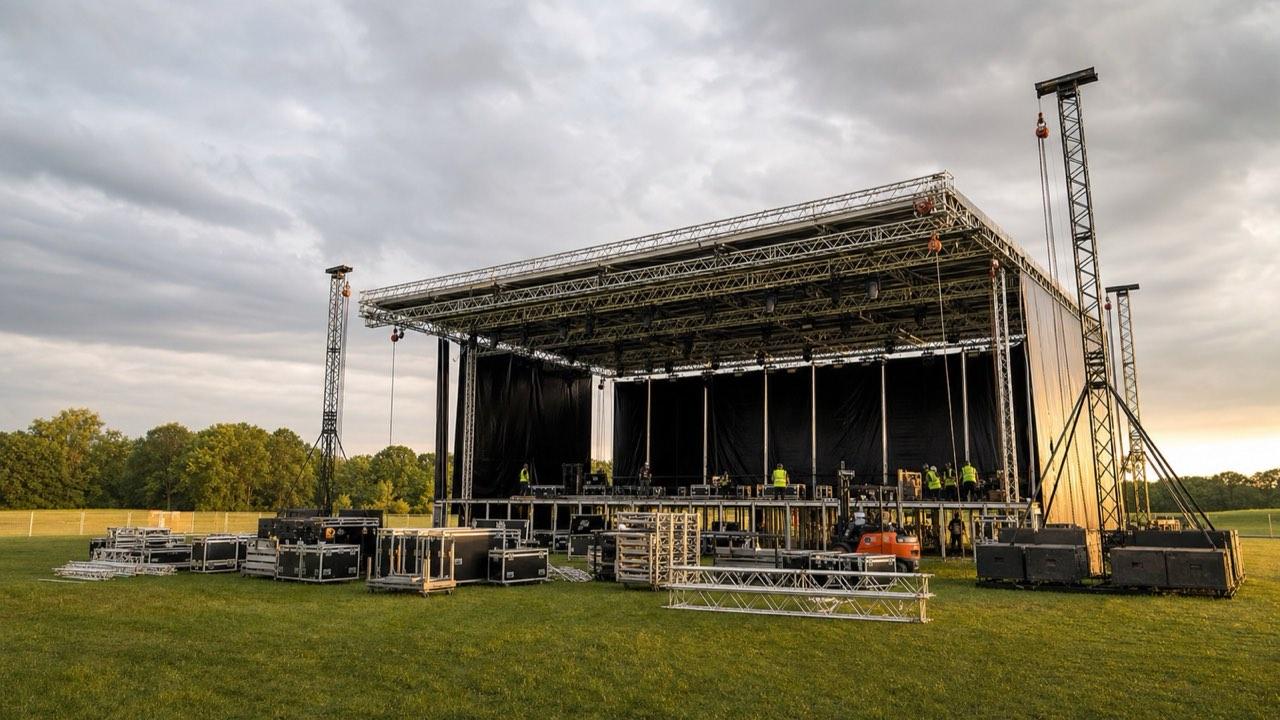
Northern New Jersey to Boston has four distinct seasons, two prevailing wind directions, and weather windows that change inside of three hours. Outdoor staging in this region requires more contingency planning than southern markets where summer weather is more predictable.
The planning starts the day the venue is locked, not the week of the event.
Wind ratings: read them before you sign
Every stage roof structure has a published wind load rating, expressed in miles per hour (mph). This is the sustained wind speed at which the structure must be evacuated or struck.
Common ratings in the rental market:
- Light truss roofs — 35 to 45 mph wind hold, 25 to 35 mph evacuation threshold
- Standard mobile stages (24x20, 32x24) — 45 to 55 mph hold, 35 mph evacuation
- Heavy festival stages with proper ballast or anchoring — 60 to 80 mph hold
- Hard-walled hospitality structures — vary widely, check engineering documents
The rating is the structure's capacity. The show's evacuation threshold is typically 10 to 15 mph below it, because crew needs time to safely lower banners, secure gear, and clear the audience before the upper number is reached.
Ballast and anchoring
Northern New Jersey, Long Island, and coastal Connecticut see frequent thunderstorm gust fronts in summer. A stage that passes wind rating on paper still fails if it is improperly weighted.
- Concrete ballast blocks — Sized to the engineering drawings. Often 2,000 to 4,000 pounds per leg for larger stages.
- Auger anchors into turf — Pull-tested. Common for festival fields with proper soil.
- Strap-downs to deadweight — When venue prohibits ground penetration (most paved venues, all stadium fields).
The most common failure we see on outdoor builds is missing or undersized ballast on the upstage edge, which is the side most likely to catch a building wind on a rear approach.
Lightning rules
Lightning is not a wind problem. It is a separate decision tree.
- Most venue insurance policies and event safety plans use the 30/30 rule — if thunder is heard within 30 seconds of seeing lightning (about 6 miles away), evacuate the stage and audience to a safe shelter for at least 30 minutes after the last strike.
- Tracking apps used in production: WeatherOps, DTN, AccuWeather Enterprise. Most stage rentals do not include lightning monitoring — book a meteorology service separately for any major outdoor build.
- The audience-facing announcement should be drafted, approved by the client, and pre-recorded before doors. Do not write evacuation copy under live conditions.
Rain planning
Water on stage is a slip and electrical hazard before it is a show problem.
- Stage decks need a non-slip surface — black tape, indoor-outdoor carpet, or coated finish
- Audio gear and LED panels need IP ratings that match the forecast
- Floor lighting and uplights along the stage edge need water-rated housings
- Cable runs need ramps that channel water away from connectors
- A rain cover for FOH (front-of-house) console and a separate one for video village
A light rain rarely cancels a show. A 90-minute downpour during load-in often delays it by half a day. Build a rain delay into the load-in schedule, not the show schedule.
The decision tree we run
For every outdoor production, the same questions get answered in writing before the venue is signed:
- What is the structure's wind hold rating and evacuation threshold?
- Who is monitoring weather on show day, with which service, and at what intervals?
- Who has authority to call evacuation, and what is the chain of communication?
- What is the shelter plan for audience and crew?
- What is the strike-and-secure protocol if a storm window opens during the show?
- What is the rain delay tolerance built into the schedule?
- Is there a rain date, a hard cancel clause, or both in the contract?
If any of these are blank when the contract is signed, the day-of decisions get made under pressure, by the wrong people, with incomplete information.
When the call gets made
We have evacuated three stages in the last five years for weather. Each one was called early — between 35 and 50 minutes ahead of the storm front — because the meteorology service flagged the trend in time. No one was hurt. Gear was secured. The shows resumed where they were able to.
The pattern in all three cases was the same: the structure was engineered correctly, the threshold was published, the monitoring was running, and the person with the authority to call evacuation was on site and reachable. Take any one of those four out and the outcome would have been worse.
We quote outdoor builds with the engineering specs, wind ratings, and evacuation protocols spelled out in the proposal. Quotes back within 24 hours.