Outdoor LED Walls: Brightness, IP Ratings, and Weather Planning
Outdoor LED walls demand the right nit output, a genuine IP65 rating, and a weather contingency plan before the first panel goes up.
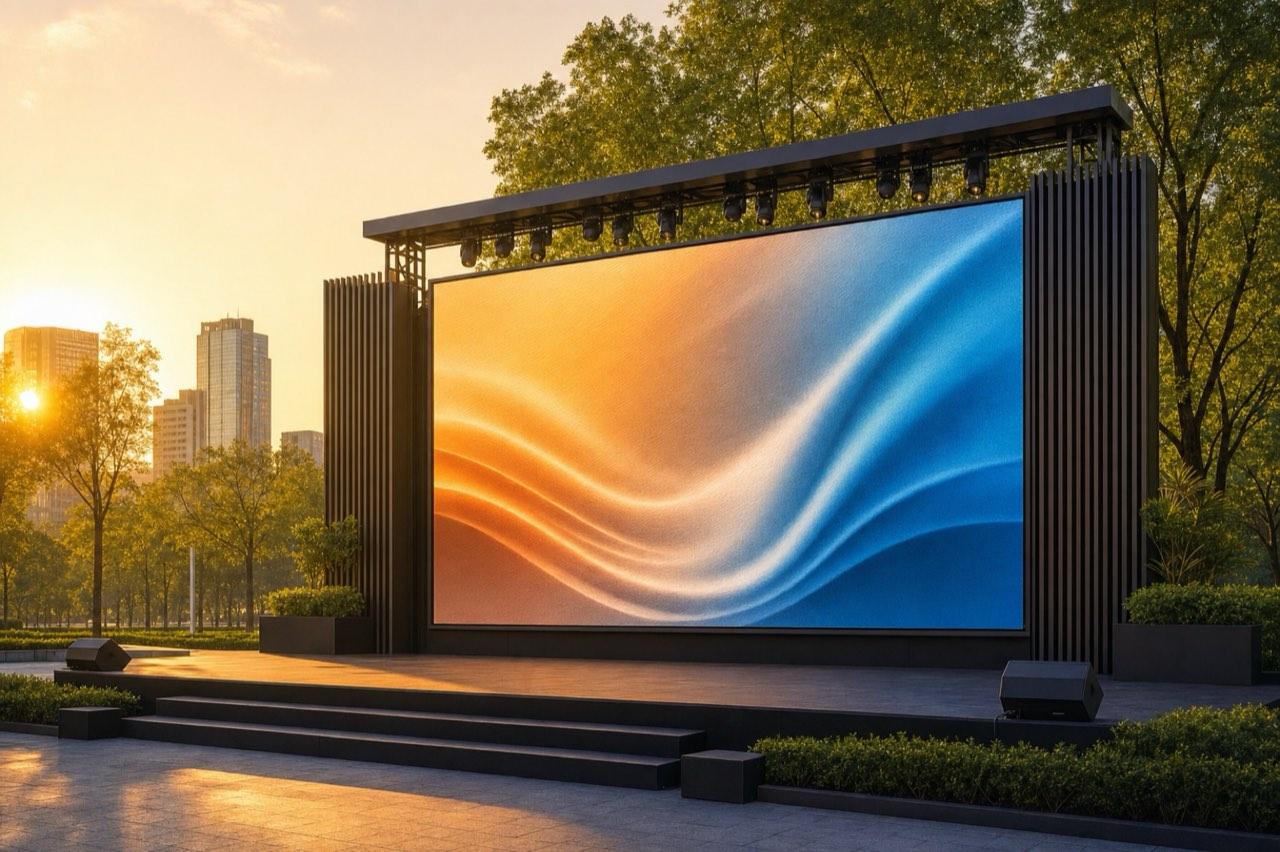
Outdoor LED walls live or die by two numbers: nits and IP rating. Get either one wrong for your venue and weather conditions, and you'll spend show day explaining to your client why the wall looks washed out at noon or why you're nervously watching the radar. We've deployed outdoor LED on rooftop terraces, park stages, festival grounds, and loading-dock-turned-activation spaces, and the spec conversation always starts in the same place — how bright does it need to be, and what is the actual weather risk?
Understanding nits for outdoor visibility
Nit output (candelas per square meter) is the single most important spec for outdoor LED. Our indoor panels typically run 800–1,200 nits, which is plenty for a ballroom with the house lights down. Outdoor in full sun is a different environment entirely. At noon on a clear day with direct sun hitting the wall face, you need a minimum of 5,000 nits to maintain acceptable contrast, and 6,000–7,000 nits is a more comfortable margin. We stock outdoor-rated panels that run up to 6,500 nits peak brightness, which handles most daytime corporate activations. For extremely high-ambient-light situations — south-facing walls at midday in summer, reflective surfaces nearby — we sometimes spec panels at 8,000 nits or add a temporary shade structure behind the viewing area.
IP ratings: what the numbers actually mean
IP (Ingress Protection) ratings are a two-digit code. The first digit covers solid particle protection (dust); the second covers liquid ingress (water). The relevant threshold for outdoor event LED is IP65 — fully dust-tight and protected against water jets from any direction. That covers rain, sprinklers, cleaning sprays, and typical outdoor splash situations. IP54, which some manufacturers describe as "weather resistant," is not sufficient for events where rain is a realistic possibility — it covers splash from limited directions only. We use IP65 as our floor for any outdoor build, and we move to IP67 (immersion-rated to 1 meter for 30 minutes) for installations near water features or in known flood-prone outdoor spaces.
The pixel pitch tradeoff outdoors
Outdoor viewing distances tend to be longer than indoor, which creates an opportunity to use a coarser pixel pitch and reduce cost. The standard rule of thumb — minimum viewing distance in feet roughly equals pixel pitch in millimeters multiplied by 10 — holds outdoors, but the arithmetic shifts with brightness. Higher-brightness outdoor panels often come in P4 (4mm) or P5 (5mm) configurations because the larger die size contributes to higher nit output. For close-range activations under 30 ft, we still push for P3.9mm or finer. For concert-scale video walls viewed from 60 ft or more, P6.25 or P8 is entirely defensible and more cost-efficient.
Wind loading and structural considerations
Outdoor LED walls are essentially big sails. A 20 ft wide by 12 ft tall wall has 240 sq ft of surface area, and at 20 mph sustained wind that's a meaningful lateral load on the ground-support structure. Our outdoor builds use engineered ground-support systems with base ballast calculated from the local wind speed design code — typically ASCE 7 for North American events. We require a structural engineer's sign-off on any outdoor wall over 16 ft in height or in an exposed location where wind gusts could exceed 35 mph. Do not accept a vendor quote for an outdoor wall build that doesn't include a wind load calculation. We've seen unsecured walls fail in wind events that were well within forecast range.
Rain plans: what triggers a pull-down
IP65 means the panels themselves can handle rain. The things that can't are the sending and receiving cards in the processor racks, the power distribution equipment, and the cable runs between. A proper outdoor install keeps all electronics in weatherproof road cases or in a covered tech position, and all connectors are either weatherproofed at the joint or positioned facing downward so water runs away. We establish a pull-down trigger protocol with clients before every outdoor show:
- Light rain under 0.1 in/hr with no lightning: run as normal
- Moderate rain 0.1–0.25 in/hr: cover tech racks, monitor cabinet seam integrity
- Heavy rain over 0.25 in/hr: pause content, monitor structural
- Any lightning within 10 miles: power down and lock out until 30 minutes clear
That protocol isn't about protecting gear for its own sake — it's about protecting crew and audience safety in a water-adjacent electrical environment.
Heat and thermal management
Outdoor panels in direct sun absorb heat fast. Our outdoor panels have fan-cooled modules that handle up to 105°F ambient, but if the wall is in direct afternoon sun and the ambient is already 95°F, thermal throttling can occur mid-show and brightness will drop automatically to protect the modules. We account for this in placement — orienting the wall so it faces east or north avoids the worst of direct afternoon sun on a summer event. When a south- or west-facing orientation is unavoidable, we build in a 15–20% brightness overhead buffer so the throttled output still meets the minimum contrast spec.
Generator sizing for outdoor LED
Outdoor LED walls draw more power than indoor equivalents because of the higher brightness and the fan systems running continuously. A 20 ft wide by 12 ft tall outdoor LED array at full brightness will typically pull 14–18 kW depending on content. Add the processor racks, distribution, and any adjacent staging elements and you're sizing a generator — a 35–50 kW unit for most typical outdoor LED deployments, with a transfer switch and a 100-ft service run if the generator can't sit adjacent to the tech position. We always size generators with a 30% reserve above calculated draw; running a generator above 80% load for extended periods accelerates wear and increases failure risk.
Condensation: the morning problem nobody mentions
On cooler mornings — or anytime there's a significant delta between the panel surface temperature and the ambient dew point — condensation can form on LED module surfaces before the wall warms up. This is most common in early-morning load-ins during humid months. We power LED walls at reduced brightness for 20–30 minutes at the start of load-in to warm the modules gradually rather than hitting full power cold. It sounds simple, but skipping this step has caused module failures on morning builds in humid coastal environments.
Permitting and load-in windows
Outdoor LED builds almost always intersect with park permits, municipal sidewalk closure permits, or venue loading restrictions that affect when the wall can go in and when it needs to come out. A 20 ft wall on a ground-support system typically requires a 53-ft truck access lane and a 60-ft clear circle for the forklift or boom lift used to position the upper cabinet rows. When those logistics don't fit the venue access plan, we downsize the wall or shift to a modular stack approach that can be hand-bombed into tighter spaces. Build this into the permit conversation early.
What changes after sunset
Everything that looked like a brightness problem at noon looks like a brightness surplus at 10 PM. Outdoor walls at night need their brightness dialed back significantly — typically to 1,500–2,500 nits — to avoid blowing out camera exposures if there's any broadcast or photography component, and to avoid creating a glare hazard for operators and audience at close range. Our processor configs include a preset schedule that reduces brightness automatically at a client-specified time, so we're not making manual adjustments in the middle of a show when something else needs attention.
Getting the spec right for your outdoor build
If you want EventProSource to spec an outdoor LED wall for your event, we can build a plan that covers brightness rating, IP certification, wind load calculations, generator sizing, and weather contingency protocols. Email hello@eventprosource.com for a 24-hour quote and a practical recommendation based on your site conditions and run of show.