What Drives LED Video Wall Rental Cost for an Event
Two LED wall quotes, two totals, no explanation. The eight inputs that move an LED video wall quote, the panel arithmetic behind them and how to read an itemized quote.
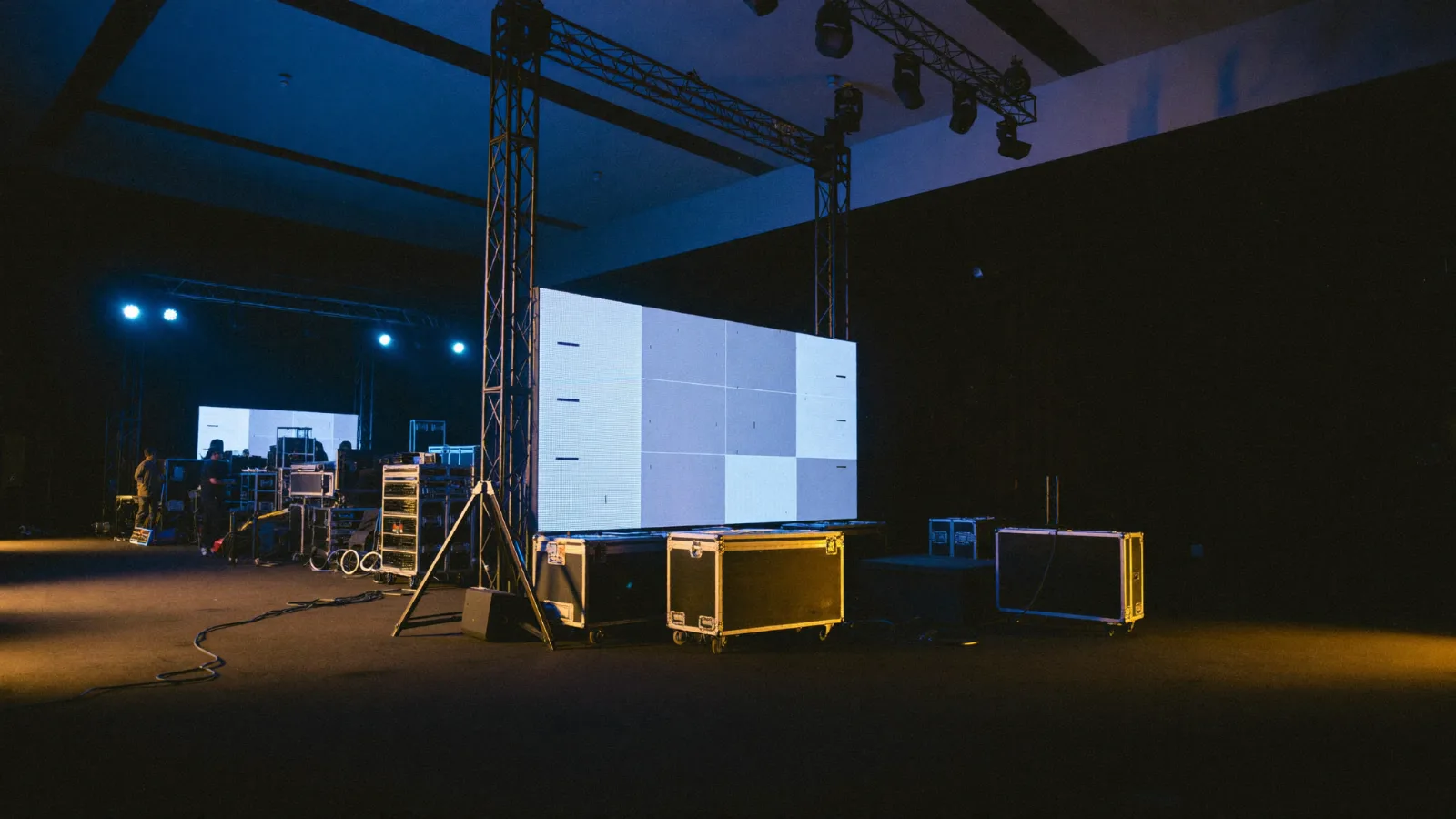
Two LED wall quotes arrive for the same general session. One total sits well above the other, neither says why, and a search for LED video wall rental cost returns day rates from other cities that describe none of your room. In our experience the gap is usually scope: a different pixel pitch, a wall that snaps to a different number of panels, a flown build in one quote and a ground-stacked build in the other.
This guide lists the eight inputs that move an LED wall rental quote, works through the arithmetic behind the two inputs planners misjudge most often, and shows how to read an itemized quote line by line. It is written for planners booking in New York, New Jersey, Connecticut and Massachusetts, and it contains no prices. A wall built to a room does not have a list price, and a figure from another venue would only mislead you.
Why LED video wall rental cost has no list price
LED video wall rental cost is set by scope, not a list price: pixel pitch, wall square footage, indoor or outdoor rating, rigging method, duration, content preparation, processing backup and venue logistics each add or remove hardware, labor or both, so two quotes for an LED wall only compare once those eight inputs match.
Pricing scales with pixel pitch, square footage, install complexity, labor, duration, and content needs. We return a fully itemized quote within 24 hours of brief.
The table below follows the cost drivers on our LED wall rental page. The order is not a ranking. Any one of them can be the input that moves your quote.
| Driver | What it changes in the scope | What to tell us |
|---|---|---|
| Pixel pitch | Pixel density, so panel hardware and processing load | Closest viewer or camera distance |
| Square footage | Panel count, which drives hardware and labor | Wall width and height, or the design |
| Indoor or outdoor rating | Outdoor modules are weatherproof and brighter, and carry a premium | Roof, tent, open air or ballroom |
| Rigging method | Flown needs truss, motors and rigger labor; ground-stacked is leaner | Venue rigging points and ceiling height |
| Duration | Multi-day rentals amortize differently than a single-day build | Load-in, rehearsal, show and strike days |
| Content preparation | Motion content that has to be built or adapted adds scope | What content exists and in what format |
| Processing redundancy | A backup processor and failover cabling add gear | Whether the show can tolerate a restart |
| Geographic logistics | Dock distance, elevator access and venue labor rules affect crew time | Venue, dock and load-in route |
Two neighbors of this question get their own treatment. If the room could go either way between LED and projection, read LED wall versus projector for a ballroom first, or ask for projector and screen rental to be quoted beside the wall. For small displays, TV and monitor rental is a different job with a different quote.
Pixel pitch: density, not just sharpness
Pixel pitch is the distance in millimeters between LEDs. On our LED wall rental page, indoor pitches run from P1.5 to P3.9 and outdoor from P3.9 to P6.6, in 500 x 500 mm and 500 x 1000 mm modules. Viewing distance picks the pitch: the page gives P2.6 as workable from 8 to 30 feet, P3.9 from 12 to 60 feet, and P1.5 for close-up broadcast or virtual production. For the viewing-distance reasoning itself, see how to choose a pixel pitch.
What the pitch does to the quote is easier to see as pixel counts. This is our arithmetic, using a 500 mm module and rounding to whole pixels. Actual cabinets follow the manufacturer's specification, so the proposal's figures are the ones to trust.
| Pitch | Pixels across a 500 mm module | Pixel density versus P3.9 |
|---|---|---|
| P1.5 | 333 | 6.8 times |
| P2.6 | 192 | 2.25 times |
| P3.9 | 128 | 1 (reference) |
| P6.6 | 76 | 0.35 times |
Density is the square of the pitch ratio: (3.9 / 2.6) squared is 2.25. Moving from P3.9 to P2.6 more than doubles the pixels in the same footprint, and every one of them has to be driven by the processing. More pixels per square foot means more panel hardware and more for the processors to carry, which is why our page says a finer pitch carries higher hardware cost and needs more precise rigging. That is the reason to choose the coarsest pitch the closest viewer will accept, and not a finer one for comfort.
Square footage: the wall snaps to the panel grid
A wall is not built to the foot. It is built in modules, so a small change in width can move a whole column of panels. Here is a worked example, using our planning assumption of 500 x 500 mm modules. Our LED wall rental page cites an 18 foot P2.6 wall for corporate general sessions and 18 to 24 foot keynote walls for rooms of 300 to 1,000 people, so we start there.
- An 18 foot wide wall is 5,486 mm, which rounds to 11 modules across (5.5 m, or 18.0 feet).
- A 10 foot high wall is 3,048 mm, which rounds to 6 modules high (3.0 m, or 9.8 feet).
- That is 66 modules.
- Widen the wall to 20 feet and the width is 6,096 mm, which rounds to 12 modules across. Twelve by six is 72 modules, six more.
The pixel canvas follows from the pitch. On the 11 by 6 wall, P2.6 gives 2,112 x 1,152 pixels, about 2.4 million. P3.9 gives 1,408 x 768, about 1.1 million. Those dimensions are the canvas your designer builds to, and matching content to the wall's pixel map is worth doing before the files are final.
This is also the honest answer to the common search for LED wall cost per square foot. The unit that moves the quote is the module count, together with the pitch and the structure that carries it. A flat rate per foot hides all three.
Indoor or outdoor: brightness, rating and wind
Our LED wall rental page lists indoor panels at 800 to 1,500 nits and outdoor panels at 5,000 to 7,000 nits, with outdoor pitches from P3.9 to P6.6. Our page notes that weatherproof outdoor modules carry a premium over indoor ones, and they bring structure and wind with them.
Our guide to outdoor LED walls treats IP65 as the working floor for an outdoor build and says a quote for an outdoor wall should include a wind load calculation. Use that as a test. An outdoor quote with no wind load line, or with ballast that is not tied to a wind speed, is incomplete, whatever its total says.
Install complexity: rigging, power and venue rules
Rigging method changes scope more than it changes the picture. A flown wall needs truss, motors and rigger labor. A ground-stacked wall sits on a leaner base frame. Which one is possible depends on the room: ceiling height, the venue's rigging points and what the building will let you hang. For flown walls, structural engineering letters and venue rigging approvals are part of the job, and how point loads are checked is the background for reading that section of a proposal.
Shaped walls add engineering. A concave arc or a column needs a rigging plot and load calculations before anything ships. If curves are on the table, curved LED walls covers when the geometry is worth it.
Power is the other line people forget. Our LED wall rental page lists single-phase and three-phase power, and the right choice depends on the venue's distribution. Event power distribution explains what the quote should assume. Then come venue labor rules, dock access and elevator capacity, which change crew time before a panel is unboxed.
One thing a quote should always say: who rigs, and who signs off. EventProSource is a production partner, not a warehouse. We source vetted local crews and gear per metro and match the right gear for the room, which is why the panels, structure and labor in a quote differ from one venue to the next. A quote that cannot say which crew rigs the wall is not finished.
Duration, content and backup
Days on site
State load-in, rehearsal, show and strike separately. A wall that stays up overnight needs an answer for power and for security, and a single-day build and a four-day run do not amortize the same way. If a quote shows one number for "event day," ask how many days of hardware and labor are inside it.
Content
Give the designer the pixel dimensions from the section above. Decide who builds the motion loops and who tests the files against the wall before doors. If motion content has to be built or adapted, that is added scope, and it is easier to price when it is named in the brief than when it appears the week of the show.
Backup
A proposal should name the backup processor and the failover cabling, and say where spare panels sit. This is the line to read most carefully if your show cannot stop. Ask what happens when a processor fails during a keynote and who on the crew is responsible for the switch.
How to read an itemized LED wall quote
An itemized quote separates the lines that move. These are the lines to look for and what to ask when one is missing.
| Line | What it should state | If missing, ask |
|---|---|---|
| Panels | Pitch, module size, module count, wall dimensions | What are the exact dimensions and the pitch? |
| Processor and spares | Processor model class and spare panel and processor plan | What fails over, and to what? |
| Structure | Frame, truss, motors, ballast | Is it flown or ground-stacked, and who engineered it? |
| Labor | Roles and call times | Who is on the crew at load-in and at show? |
| Power and distribution | Service type and distribution | What does the wall need from the venue? |
| Playback and content | Playback system, content tasks, test time | Who delivers files, and when are they tested? |
| Transport, dock, load route | Dock access and elevator assumptions | What did you assume about the load-in path? |
| Days on site | Load-in, rehearsal, show, strike | How many days are inside the total? |
| Permits and venue fees | Who pays and who applies | Which fees are in this quote and which are not? |
To compare two quotes, put them on the same inputs first: the same pitch, the same wall dimensions, the same rigging method. Then compare totals. A quote that states a pitch and a wall size to the nearest module is easier to trust than one that says "LED wall, 18 ft." If the inputs change after you have quotes in hand, revising a quote without losing scope keeps the lines intact. For a full room package, ask for the wall to be quoted inside A/V equipment rental so the audio, lighting and show control are priced to the same assumptions.
What to put in your brief
Each item feeds one of the drivers above.
- Wall width and height, or the design file (square footage, pitch)
- Closest viewer or camera distance (pitch)
- Indoor or outdoor, and sun exposure (rating, brightness)
- Flown, ground-stacked or "advise us" (rigging)
- Venue, dock and load route (logistics)
- Load-in, rehearsal, show and strike days (duration)
- Content type, who delivers the files and when (content)
- Live camera feeds, or playback only (processing, signal)
- Whether the show can tolerate a restart (redundancy)
A one-page brief or a phone call both work, and nothing needs to be final. A wall size you are unsure about is still a usable starting point, because the quote will show what a different width does. When you are ready, request an itemized quote. We return a fully itemized quote within 24 hours of brief, with the eight inputs above on separate lines so you can see what each one adds to the scope.
Frequently asked
There is no single price. Pricing scales with pixel pitch, square footage, install complexity, labor, duration, and content needs. Day rates published online come from other cities and different builds, so they do not describe your room. A quote is only comparable with another once the pitch, wall size, rigging method and number of days on site match.
Yes. A finer pitch puts more pixels in the same footprint, which means more panel hardware, more for the processors to drive and tighter rigging tolerances. Viewing distance decides the pitch. Choose the coarsest pitch that the closest viewer or camera will accept, then confirm it against the room before the quote is final.
A flown wall usually carries more scope: truss, motors, rigger labor, structural letters and venue rigging approvals. A ground-stacked wall sits on a leaner base frame. The room decides which is possible, since ceiling height and the venue's rigging points limit what can hang. Ask for both builds to be quoted when the room allows either.
Video wall is a loose term. It can mean tiled LCD displays or LED panels. An LED wall is built from modular LED panels sized to the room, in whatever pitch the viewing distance needs. For small single displays, TV and monitor rental is usually the better fit.
Send the wall width and height or the design, the closest viewer distance, indoor or outdoor, flown or ground-stacked, the venue and dock details, the load-in to strike days, who delivers the content, and whether the show can tolerate a restart. A one-page brief is enough. The itemized quote returns within 24 hours.