LED Wall vs Projector for a Ballroom: How to Choose
LED wall or projector for a hotel ballroom general session? Compare ceiling height, ambient light, throw depth, load-in and cost drivers before you book.
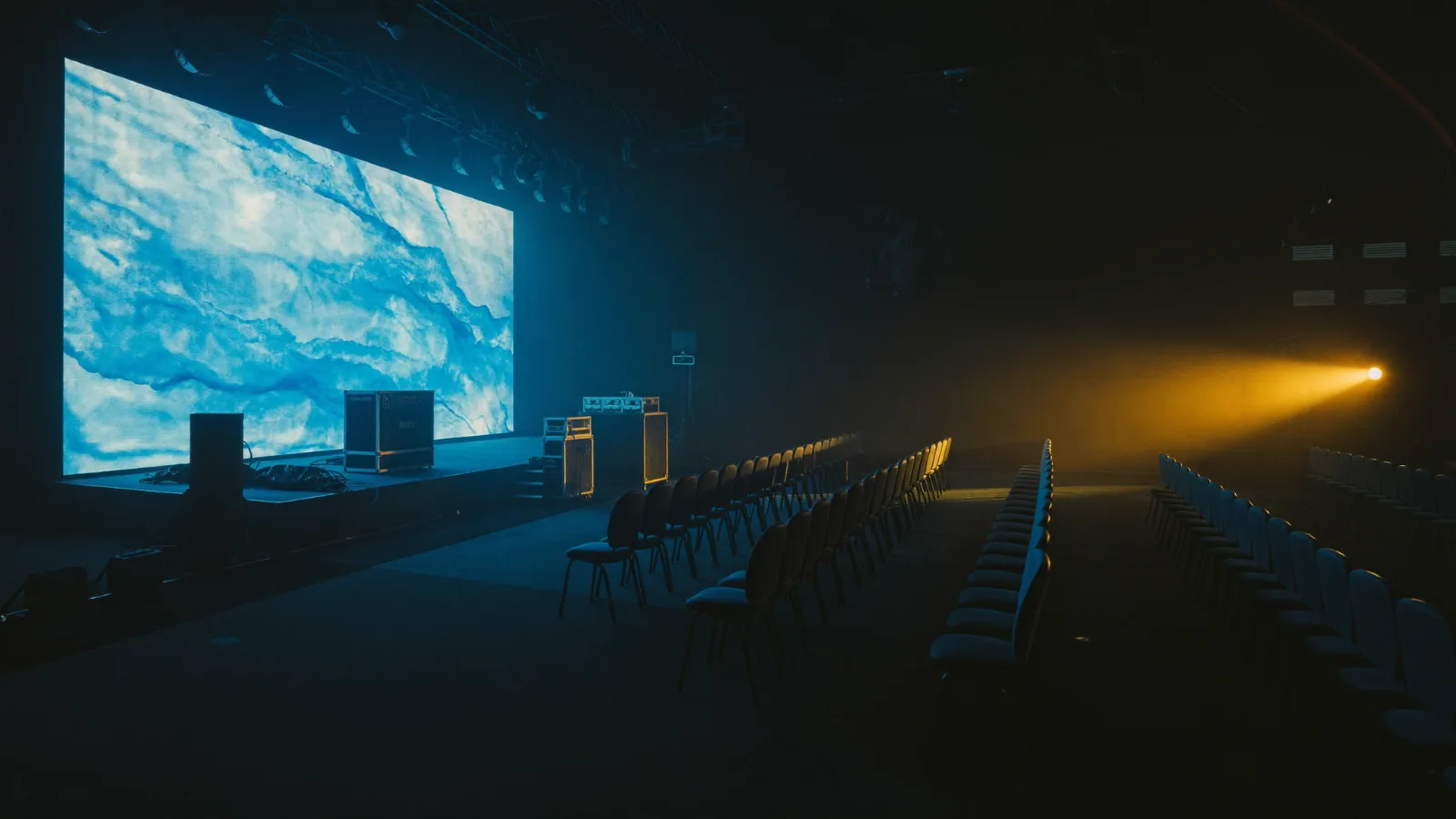
You have a general session booked in a hotel ballroom, a deck that needs to be readable from the back row, and two proposals on the table: one with an LED wall, one with projection. They look similar on paper and nothing on either quote tells you which one the room can actually carry. The decision comes down to ceiling height, ambient light, stage depth, sightlines and what your content looks like, and each of those is something you can check before you sign.
This guide walks through how we compare an LED wall vs projector for ballroom and conference work in New York, New Jersey, Connecticut and Massachusetts, and where each one fails. We are a brokerage, so the recommendation follows the room, not whatever gear happens to be sitting on a shelf.
What is the real difference between an LED wall and a projector?
An LED wall is a grid of emissive panels. Every pixel makes its own light, so the image does not depend on a screen surface or on how dark the room is. A projector throws light from a lens onto a screen, and the picture you get is the projector's light minus whatever light the room adds on top.
That single difference explains most of what follows. LED holds contrast when the house lights are up and when a stage wash hits near the screen. Projection gives you a very large image from lightweight, quick-to-place hardware, but it needs a controlled room and enough throw distance. Neither is better in general. Each one is better in particular rooms.
Start with the room: ceiling height, rigging and depth
Measure before you compare. Three numbers decide more than any spec sheet.
Ceiling height and screen size
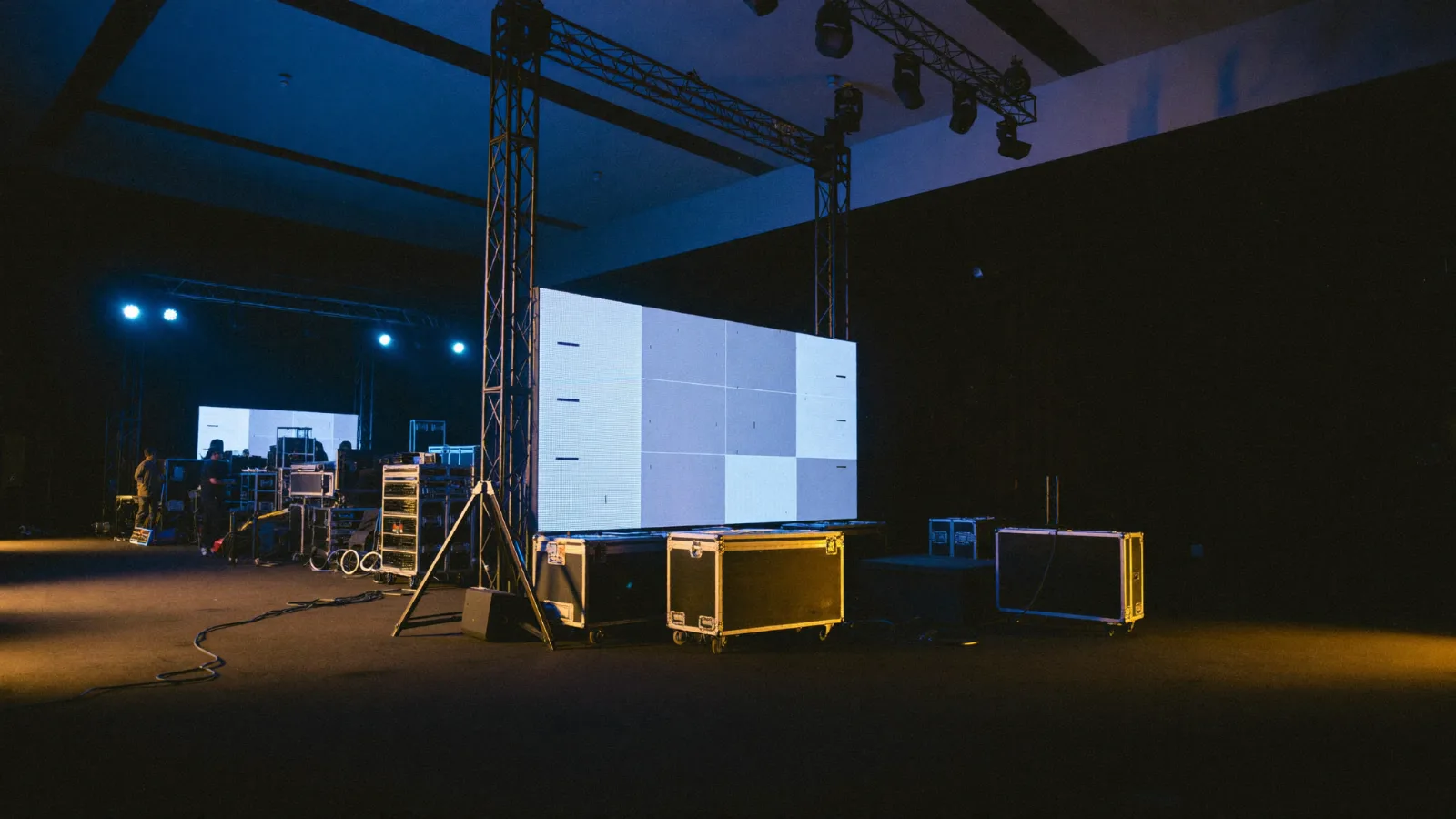
Work out the image height first. A 16:9 image is a little over half as tall as it is wide, so every extra foot of width adds more than half a foot of height. The bottom edge has to clear the heads of the people in the back rows, which usually means a stage deck, and the top edge has to clear the ceiling and anything hanging from it. Read the venue's published ceiling height, then confirm it on the site visit. Many hotel ballrooms have lower ceilings than planners remember, and chandeliers, air walls and sprinkler heads take more space again. LED can be ground-stacked on a base frame or flown from motors. A projection screen on a fast-fold frame needs the same vertical space with less structural load.
Rigging points
Flying an LED wall means panels, frames and motors hanging from points the venue has approved. Hotels often limit the weight per point and require their own rigger or an engineer's sign-off. If the ballroom cannot take a flown load, a ground-supported LED wall with ballast is an option, and so is a projection screen that stands on its own frame. Ask for the venue's rigging specification early. The rigging load calculations we use for plots cover how those point loads are checked.
Depth behind and in front of the screen
Rear projection puts the projector behind the screen so nothing blocks the beam. The distance from lens to screen is set by the lens's throw ratio, which is the throw distance divided by the image width, and the manufacturer lists the range for each lens. Multiply that ratio by your image width, add room for the crew to work behind the screen, and you have the depth you need to find. In a ballroom that usually means a pipe-and-drape wall set far upstage, and many rooms cannot spare the depth.
Front projection places the projector in the audience area or on a high truss position. It saves depth but costs floor space, and a head, a camera or a server table in the beam shows up on the screen. LED needs only the depth of its own frame and a service aisle.
Ambient light: where projection loses most often
Ballrooms are not black boxes. There are exit signs, window leaks, foyer doors, and a stage wash that someone wants bright enough for a camera. Projection suffers from all of it, because stray light lifts the black level and the picture goes grey.
Brightness helps, but only up to a point. A larger image spreads the same light over more area, so the bigger the screen and the more light in the room, the more projector output you need, and a lifted black level still limits contrast. An LED wall is emissive, so the stray light has far less effect on the picture, and the processor can set the wall's brightness for the room, which is why it stays punchy under stage lighting. If your program has a lit stage, a presenter in a bright suit and a camera feed, LED handles that mix more forgivably.
If the room can go truly dark, as in an awards screening or a product reveal, projection recovers a lot of ground. The question is whether the room will stay dark for the whole day or only for twenty minutes.
Image quality, viewing distance and content
Pixel pitch versus projector resolution
With projection, native resolution is fixed by the projector. With LED, resolution depends on pixel pitch and wall size, and a finer pitch lets the first row sit closer. In a ballroom general session the first row is usually set back from the stage, so you are not forced into the finest pitch. Our guide to choosing LED wall pixel pitch covers the sizing in detail.
Aspect ratio and seams
Projection is locked to the projector's aspect ratio unless you edge-blend two or more units into a wider canvas, which adds alignment time and a visible blend zone if it drifts. LED is modular, so a wall can be 16:9, ultrawide, or a tall column. That flexibility is why wide stage backdrops and non-standard shapes are usually LED. Match your content to the screen before the event; our notes on LED wall content resolution and pixel mapping explain how to build slides at the canvas size instead of letting the processor scale them.
Camera and streaming
If the session is recorded or streamed, check how the screen behaves on camera. LED walls need the camera shutter and the wall's refresh rate to cooperate or you see banding and flicker. A competent crew sets this at the first camera check, but it should be on the checklist. Projection is generally easier on cameras, with the trade-off that a washed-out screen looks washed out on the stream too.
Load-in, power and crew
Projection is lighter and faster. A screen, a projector, a lens and a media source can be placed and aligned in a fraction of the time an LED wall takes to assemble, test and calibrate. In a New York hotel where you may have a freight elevator window and a limited load-in block, that matters.
LED has more cases, more cable and more power. A ballroom wall can need dedicated distribution and a technician who stays with it for the show. Confirm available power with the venue's chief engineer rather than assuming the room's outlets will carry it; the event power distribution basics guide shows what to ask.
Neither option is a single-person job at general session scale. The crew size changes with the wall size, the number of projectors and the number of cameras, which is part of why cost scales the way it does.
Side-by-side comparison
| Factor | LED wall | Projection |
|---|---|---|
| Works with house lights up | Yes, within reason | Limited; contrast drops |
| Needs controlled darkness | No | Strongly preferred |
| Depth required | Frame and service aisle | Throw distance behind or in front |
| Ceiling height | Flexible; ground-stack or fly | Needs clear height for image |
| Aspect ratio | Set by panel layout | Fixed unless edge-blended |
| Load-in time | Longer | Shorter |
| Power draw | Higher | Lower |
| Seams | Panel joins, usually minimal | Blend zones if multiple units |
| Best fit | Lit stages, wide or odd shapes, streamed shows | Dark rooms, breakouts, quick turnarounds |
Which one fits your event
Choose LED when the stage is lit, the room has windows or open doors, the wall has to be an unusual shape, or the show goes to camera. Choose projection when the room can be dark, when you have the depth for rear projection or a clean front-throw position, and when load-in time is tight. Many productions use both: an LED wall as the main image and projection or TV and monitor rental for side screens, confidence displays and lobby signage.
If your event is closer to meeting-room scale, read how conference room and ballroom A/V differ, because a screen that works in a boardroom does not simply grow into a ballroom.
What drives the cost of each option
Pricing scales with pixel pitch, square footage, install complexity, labor, duration, and content needs. We return a fully itemized quote within 24 hours of brief. A wall that must be flown, stays up for several days and needs a content operator is a different scope from a ground-stacked wall for a half-day. A large projection setup with edge-blending and a dedicated operator is also a different scope from a single projector on a stand. We do not publish numbers because the room decides them, and the itemized quote shows what each line is doing.
How we spec it
We start with the venue's floor plan, the ceiling height, the rigging specification and the run of show. From there we look at where the screen goes, who needs to see it, and how the program is lit. Because we source vetted local crews and gear in each metro, we are not trying to fit a fixed inventory into your room. If the room wants an LED wall, we scope the LED wall rental. If it wants projection, we scope projector and screen rental. And when the program needs audio, lighting and cameras around the screen, we price the full A/V equipment rental package as one plan.
Send us the room and the run of show
The fastest way to settle LED versus projection is to send the venue name, the ballroom or room name, attendance and a rough program. We will tell you which one we would put in, and why, and give you a fully itemized quote within 24 hours. Request a quote with those details and we will work from there.
Frequently asked
It depends on the room. An LED wall holds contrast with the house lights up, suits lit stages and streamed shows, and fits odd shapes. A projector fits rooms that can go dark and have the depth for the throw. We check ceiling height, rigging points, ambient light and stage depth before recommending either.
Only to a limited degree. Stray light lifts the black level, so the picture loses contrast and looks washed out, especially on camera. More projector output helps, but it does not fix a bright room. If the lights must stay up, an LED wall is usually the safer choice.
It depends on the lens. The lens's throw ratio, listed by the manufacturer, multiplied by your image width gives the distance from lens to screen. Add working space for the crew behind the screen. Many ballrooms cannot spare that depth, which is one reason LED or front projection is often chosen.
Pricing scales with pixel pitch, square footage, install complexity, labor, duration, and content needs. We return a fully itemized quote within 24 hours of brief, so you can compare the two options line by line for your venue.