Outdoor Lighting: IP-Rated Fixtures, Power, and Weatherproofing
Outdoor lighting succeeds when the whole system is weather-ready: fixtures, power, data, routing, and a clear rain plan.
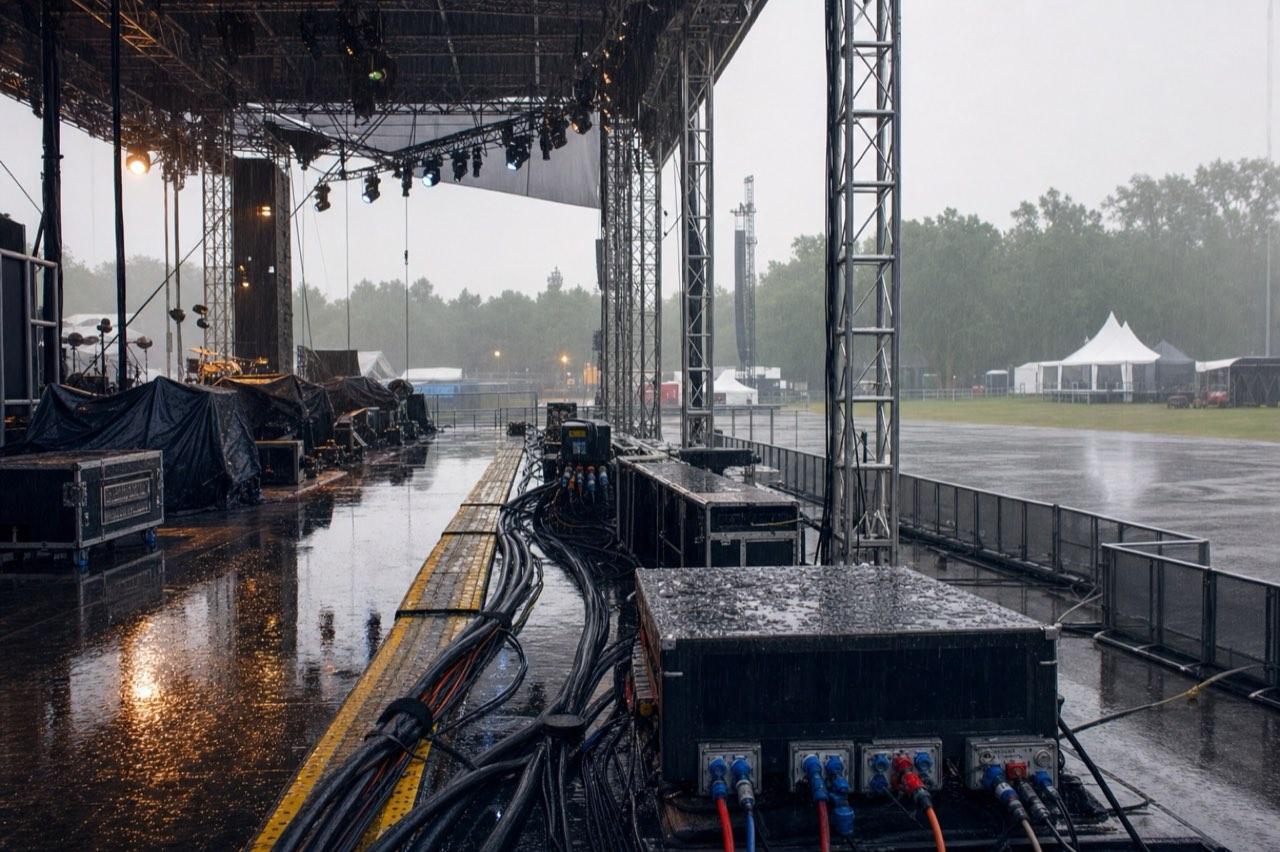
When you’re loading in outdoors and the radar turns purple, lighting becomes less about “looks” and more about “stays on.” Water finds the weak points: the wrong connector at the wrong height, the missing drip loop, the power distro sitting in a puddle, the fixture that was “fine last weekend.” If you plan for weather like it’s part of the show design, you can keep the stage readable, the audience safe, and the troubleshooting to a minimum.
start with the weather, not the fixture list
Outdoor lighting plans fall apart when weather is treated as a last-minute note. We plan it the other way around.
- Wind and precipitation drive your mounting choices. A moving head on an exposed pipe at 20 feet in gusts is a different animal than the same unit under a roof with sidewalls.
- Rain changes your priorities. In steady rain, you’re trying to keep critical areas lit (stage edges, stairs, ramps, FOH positions, backstage paths) while protecting gear and keeping GFCI nuisance trips under control.
- Heat and sun matter too. Direct sun on black road cases, distro lids, and LED fixtures can push temps up fast and trigger thermal limiting. Shade and airflow are part of the plan.
Our best outdoor shows start with a simple question: what conditions are plausible between load-in and load-out, and what do we do when we get them.
ip ratings: what they mean in real show conditions
IP ratings are a helpful shorthand, but they don’t replace good practices.
- IP65 is the common target for rain. It generally means dust-tight and protected against water jets, which is a decent proxy for “can live outdoors if we don’t do anything reckless.”
- IP54 is not a rain plan. It may survive a misty night, but it’s not the same as hours of rainfall plus wind.
- IP rating is about the enclosure, not your entire system. The fixture might be sealed, but your power, data, connectors, and mounting points can still be the failure.
We treat IP as a starting filter, then we design the whole chain: power in, data in, mounting, cable routing, and how the unit is serviced when it’s wet.
fixture selection: the outdoor shortlist (and the tradeoffs)
Outdoor fixtures are never “best,” they’re “best for this job.” Here’s how we usually sort them.
ip-rated washes for coverage and speed
For most outdoor stages, IP-rated LED washes do a lot of work: base color, stage coverage, audience looks, and architectural hits on nearby structures.
- They’re fast to deploy
- They’re forgiving when weather shifts
- They’re efficient on power compared to discharge fixtures
Tradeoff: if you need long-throw punch from FOH to a deep stage, a wash may not have the intensity you want without adding more units.
ip-rated profiles and spots for key light and texture
If the show needs identifiable faces on camera (or just for the room), IP-rated profiles/spots earn their keep.
- Better beam control
- Cleaner shuttering (useful when you’re trying not to light the roof, the IMAG wall, or the backstage clutter)
- Stronger punch for key and specials
Tradeoff: they cost more per “useful lumen,” and you’ll feel it if you’re covering a wide stage.
beam fixtures: use with intent
Outdoor beam fixtures look great in haze, but haze outdoors is not a guarantee. Wind can turn your “big moment” into nothing.
We use beams outdoors when:
- the stage is partially sheltered
- we can place haze in protected pockets
- the show has enough fixtures that losing some beam definition isn’t catastrophic
blinders and strobes: weather-friendly, but mind the power
Blind and strobe looks can be very effective outdoors because the ambient light is often higher than you expect.
Tradeoff: blinders can be power-hungry, and strobes can be a cueing/comfort issue if the audience is close. Also, every extra amp matters when your distro is already feeding audio, video, and comms.
the real weak points: connectors, cable routing, and water paths
Most outdoor lighting failures aren’t the fixture. They’re the “in between.”
connectors: choose the right family and keep them mated
- Use outdoor-rated power and data connectors where possible. The right connector with the right mating half maintains the seal.
- Don’t leave connectors open to the sky. Unused tails should be capped, bagged, or stowed under cover.
- Avoid adapters as permanent outdoor solutions. Every adapter is another interface for water to find.
drip loops and gravity
Water runs downhill and wicks along cables. A drip loop is just a low point below a connector so water falls off before it hits the connection.
If you take one outdoor practice seriously, take this one.
keep connections off the deck
A connector sitting on wet decking is a slow-motion problem. Raise it:
- on truss cord lacing
- on cable hooks
- on a short standoff
- or route the cable so the connector lands under cover
gaff is not waterproofing
Tape is useful for strain relief and neatness. It’s not a sealant. If you tape a connection outdoors, do it to secure it, not to “waterproof” it.
power planning: outdoor lighting is a distribution problem
You can have the right fixtures and still lose the show because power was treated casually.
start with a load estimate that has headroom
Outdoor shows tend to add “just one more”:
- extra work light
- extra backstage practical
- another run of pixel tape
- heaters or fans in tents
We plan circuits with headroom so we’re not re-balancing phases in the rain.
gfci strategy: safety first, nuisance trips second
GFCI protection is not optional. Outdoors, it’s also the source of many headaches.
What helps:
- Keep cable runs clean and dry at the distro end
- Avoid shared neutrals where they don’t belong
- Keep connectors mated and off the ground
- Separate lighting from “mystery loads” (coffee urns, catering, vendor gear)
If a circuit keeps tripping, we don’t “muscle through.” We isolate the problem, test the run, and fix the water path.
cam-lok and feeder: treat it like the critical path
If you’re on a generator or tie-in, feeder becomes the lifeline. Outdoor feeder management should include:
- clear route planning (no puddle valleys)
- ramping or matting where necessary
- strain relief and proper terminations
- protected distro placement (under roof, in a tent, or on decking)
data and control: dmx, sacn, and the outdoor reality
Outdoor control networks fail for the same reasons as power: water, strain, and bad routing.
choose your control topology based on distance and access
- Short and simple: DMX can be fine when runs are manageable and you can keep splits dry.
- Distributed systems: sACN/Art-Net with nodes can reduce long DMX runs, but it introduces networking gear that must also be protected.
protect your nodes and splitters
A node in the wrong place can take down half the rig. Outdoors, we prefer:
- nodes mounted under cover
- nodes kept off the ground
- cable glands or sealed pass-throughs for tented locations
label and map like you’re going to troubleshoot wet
You will be slower outdoors. Gloves, ponchos, low light, wet tape labels that smear. We use labeling that survives:
- laminated or vinyl labels
- sharpie on white gaff with a clear overwrap
- a clean universe/address map at FOH and backstage
rigging and mounting: wind is a design input
Wind load is real, and the safest outdoor lighting plan is the one that assumes gusts.
avoid “flagging” fixtures on exposed pipes
Big housings, barn doors, and accessories catch wind. If we need the look, we:
- mount under roof when possible
- reduce sail area
- use appropriate clamps and safeties
- check torque and orientation
ground support and towers: respect the manufacturer limits
Outdoor stages often involve ground support systems and towers. The limits are not suggestions.
We plan fixture placement around:
- allowable point loads
- wind-rated configurations
- ballast and base requirements
If the stage is near its wind limit, we shift looks toward lower, sheltered positions rather than trying to “power through” with more gear up high.
sightlines and audience safety: light the paths, not just the stage
Outdoor sites have more trip hazards: cable ramps, uneven ground, wet decking, and temporary stairs.
We always include lighting for:
- stage stairs and ramps
- FOH mix area access
- backstage paths between stage, dressing, and production
- generator and distro access (so techs aren’t walking blind)
Here’s a short checklist we use as the site gets dark:
- stairs/ramp edges readable from 20–30 feet
- no dark pockets at cable ramps
- work light in backstage corners where hands are on gear
- FOH has enough light to patch and label without blasting the audience
It’s not glamorous, but it’s how you prevent injuries and keep crews moving.
work lights and practicals: the overlooked gear that saves the day
Outdoor shows live and die by work light.
- Battery work lights for fast coverage
- Low-glare task lights at FOH and backstage tables
- Practical lamps in tents to reduce the “headlamp-only” vibe
The goal is to keep critical areas usable without turning the site into a construction zone.
rain procedures: what we do when it starts coming down
When rain hits mid-show, the crew needs a plan that doesn’t require a meeting.
pre-define the thresholds
We define what triggers action:
- light rain: monitor, keep connectors off deck, maintain coverage
- steady rain: protect distro openings, minimize re-patching, limit risky climbs
- lightning in area: suspend work at height and follow site safety protocol
protect the control positions
FOH and backstage control areas need:
- pop-up tent or roof cover where allowed
- sidewalls if wind-driven rain is likely
- cable entry that doesn’t become a funnel
prioritize what must stay on
If we need to reduce complexity, we keep:
- key light and basic stage coverage
- safety lighting on paths
- minimal effects looks
And we avoid:
- unnecessary fixture resets
- opening distro lids unless we’re fixing a real problem
- re-terminating in wet conditions
post-rain recovery: drying, testing, and not trapping water in cases
The end of the night matters. Packing wet gear wrong is how you create failures for the next show.
- Wipe down fixtures and cable where possible
- Let gear drain before closing lids
- Keep wet cable separated so it can be dried and tested
- Inspect connectors for water ingress and corrosion
We’d rather take an extra 30 minutes drying and sorting than spend the next load-in chasing intermittent faults.
what to tell us when you’re quoting an outdoor lighting package
Outdoor lighting quotes move faster when we get the right details up front:
- venue/site address and surface type (grass, asphalt, decking)
- stage dimensions, roof height, and any tower positions
- power source (generator vs tie-in) and distance to stage
- expected show time, sunset time, and whether cameras are in play
- weather plan (tents, sidewalls, cover at FOH/backstage)
- any noise restrictions (generator placement can affect this)
If you don’t have all of it yet, that’s normal. We can make assumptions, but we’ll call them out so you can validate.
the bottom line: outdoor lighting is systems thinking
IP-rated fixtures help, but the outdoor win is a system: protected power, smart routing, good labeling, safe mounting, and a rain plan that’s practiced.
If you want EventProSource to spec an outdoor lighting package that covers IP-rated fixtures, protected power distribution, and a weather-ready operating plan, email hello@eventprosource.com for a 24-hour quote and a practical recommendation based on your run of show.