Projection Mapping Basics for Experiential Activations
Projection mapping looks like magic when it works. It looks expensive and broken when it does not. The difference is mostly in the surface, the throw, and the content pipeline.
What projection mapping actually is
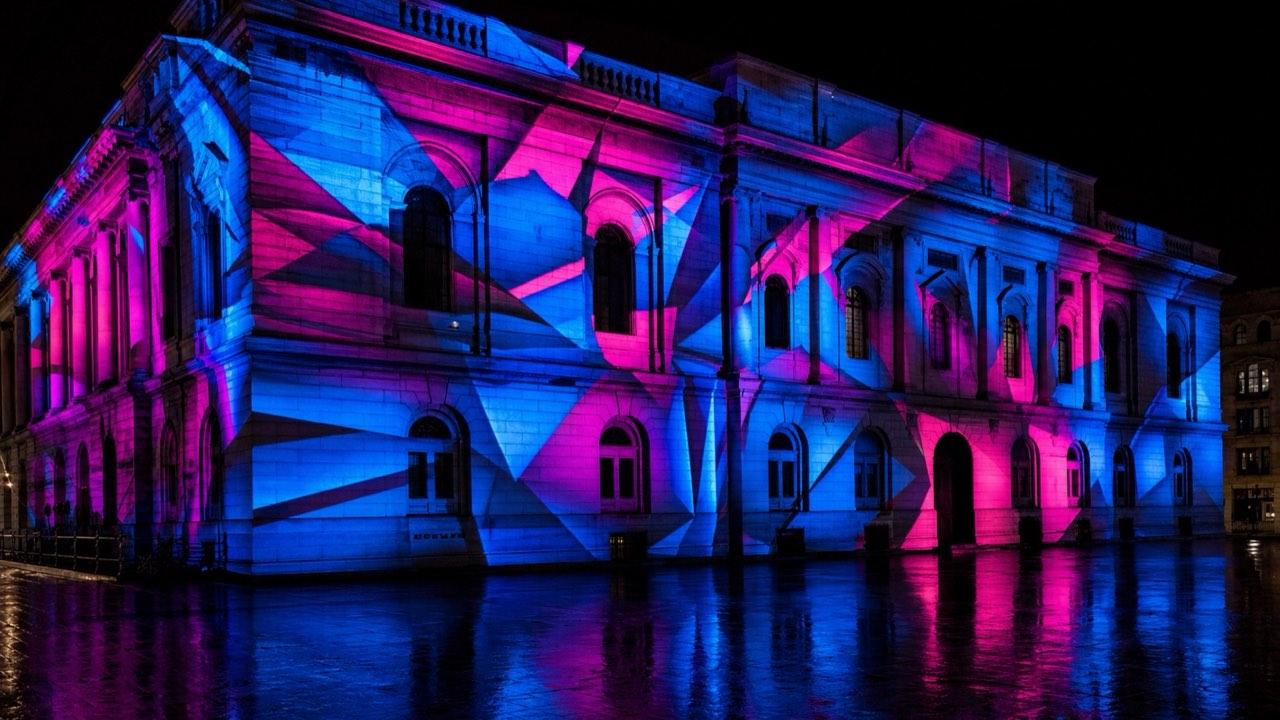
Projection mapping is the practice of projecting video onto irregular, three-dimensional surfaces — building facades, cars, stage scenery, product displays — in a way that conforms to the geometry of the surface. The result is light that appears to wrap around objects rather than land flat on a screen.
Done well, it produces some of the most memorable moments in event production. Done poorly, it looks like a misaligned slideshow. The difference comes down to four things.
The four variables that decide success
1. Surface
The surface determines how much light comes back to the audience. Light surfaces (white walls, beige stone, painted facades) reflect efficiently. Dark surfaces (brick, weathered stone, glass) absorb most of the light or scatter it unpredictably.
- Best surfaces: white or pale stone, smooth concrete, white-painted wood, fabric stretched flat
- Workable surfaces: light brick, sandstone, plaster, smooth dark walls if projectors are powerful enough
- Problem surfaces: dark brick, mirrored or reflective surfaces, heavily textured stucco, glass
If the surface is wrong, no amount of projector power fixes it. Test or visit the site in person before locking the design.
2. Throw distance and ambient light
Projectors are rated in lumens. The required lumen count depends on:
- Throw distance from projector to surface
- Surface size in square feet
- Ambient light at the site
A 30-foot by 20-foot wall in a fully dark venue can be lit with 10,000 to 15,000 lumens. The same wall outdoors at twilight with city lights nearby needs 30,000 to 50,000 lumens. Daylight projection mapping is technically possible above 60,000 lumens but rarely worth the cost.
3. Geometry and warping
The content has to match the surface. This is the part producers most often underestimate. A 90-second projection mapping piece is not a video file — it is a custom-built render created from a 3D scan or photographic survey of the target surface.
The content pipeline:
- Site survey or laser scan of the target surface
- 3D model creation
- Concept and storyboard from the creative team
- Animation and rendering against the 3D model
- On-site geometry calibration with the actual projectors
A 90-second piece for a moderately complex building facade typically requires 6 to 10 weeks of content production. Last-minute projection mapping briefs do not produce great work.
4. Calibration and playback
On-site setup includes:
- Rigging or positioning projectors at the surveyed distance and angle
- Edge-blending if multiple projectors are stitched together to cover a wider surface
- Geometry warping in software (Resolume, MadMapper, disguise, Pixera) to align the content with the actual surface
- Failover playback in case the primary playback machine drops
Most mappings need at least one full night of on-site calibration before the show. Calibrate on the wrong night and the content drifts as ambient temperature shifts the projector mounts.
Common use cases and rough scope
- Building facade mapping — Hero brand moments, public art installations. Typically 6 to 10 weeks of content, 30,000+ lumens per projector, multiple projectors edge-blended.
- Car or product reveal mapping — Auto shows, product launches. The car or object is scanned, the content wraps around it. Typically 4 to 6 weeks of content. Smaller projectors but tighter calibration.
- Stage scenery mapping — Theatrical and brand events. Set pieces are designed knowing they will be mapped. Content built into the show's overall design timeline.
- Floor and table mapping — Restaurant brand activations, museum exhibits. Top-down projection onto floors or tables. Surface flat but content must be content-aware (tracking placement of guests or food).
What to ask your producer before signing the brief
- Has anyone surveyed the target surface in person, and is there a 3D model or photogrammetry plan?
- What is the ambient light at the planned show time, and has the projector spec accounted for it?
- How many weeks does the content team need from concept lock to render delivery?
- Where will the projectors be positioned, and is that location available, secure, and weather-protected?
- What is the calibration window before the show, and what is the contingency if calibration runs long?
- Is there a backup playback machine and a manual failover plan?
Most projection mapping briefs fail because the timeline assumes content production is fast. It is not. Plan eight weeks minimum from brief lock to show for any custom mapped piece, ten or more for a complex facade.
We spec projection mapping productions end-to-end — survey, content pipeline coordination, projector spec, calibration, and show operation. Quotes back within 24 hours.