Brand Activation Build Timelines: What Is Realistic
Build time is where brand activations win or lose. Here’s how we plan load-in, approvals, and contingencies without burning the schedule.
You’ve got a footprint, a render, a client who wants it to look like the deck, and a venue that’s happy to rent you the room but not thrilled about your timing. That’s the reality of brand activation builds: the calendar is usually the hardest constraint, and every other decision is downstream of it.
When we’re asked “is this timeline realistic,” we don’t answer from vibes. We walk the build backward from doors, map dependencies (power, rigging, content, safety), and then decide what has to simplify to fit. This post is the framework we use so you can set expectations early and protect the show.
start with the immovable: doors, rehearsals, and venue rules
A realistic build timeline starts with the parts you can’t negotiate:
- Doors / attendee access: the time your space must be camera-ready and guest-safe.
- Internal run-throughs: even if it’s not “rehearsal,” someone needs to walk the experience end-to-end.
- Venue access rules: dock hours, freight elevator reservations, quiet hours, and when you’re allowed to fly or drill.
- Fire/life safety constraints: egress width, exit signage visibility, drape ratings, and anything that changes occupancy or exits.
We treat these as hard stops, then build the work plan around them. If doors are at 9:00 AM and the venue says the floor must be clear by 8:00 AM for cleaning and security sweep, your true deadline is 8:00 AM, not 9:00. If drape is part of the build, pipe and drape for ballrooms covers the flame certificate and sprinkler clearance questions to settle with the venue early.
define “build complete” so nobody argues at 2:00 AM
Most timeline arguments happen because “done” means different things to different people. For us, “build complete” is not “the scenic is standing.” It’s:
- All gear is in position and powered
- All cable paths are protected and taped or ramped
- All truss/rigging points are finished, trimmed, and inspected
- Content is loaded and playing correctly on every surface
- Audio is passing program where needed and muted where it shouldn’t bleed
- Lighting looks like the intended state in at least two looks (house + show)
- The activation can be walked safely by someone who’s never seen it before
If you write this definition into the plan, you stop the late-night scope drift where “just one more thing” becomes three more departments.
the core timeline blocks we assume for most activations
Every activation is different, but the blocks repeat. Here’s a practical way to chunk the build so you can estimate time and staffing.
1) pre-production: approvals, drawings, and site reality
If the plan isn’t approved, the build is already late. The earlier you lock these, the more predictable load-in becomes:
- Final footprint and elevations
- Rigging plot (if any) and point approvals
- Power requirements and tie-in plan (or distribution from house)
- Network plan (if there’s any interactive, registration, or content playback)
- Content specs for every display surface (resolution, aspect ratio, orientation)
- Safety notes: edge protection, stanchions, ADA paths, and egress
The hidden killer is late content changes. A “simple” content swap can force re-mapping, re-scaling, or re-routing signal if the specs weren’t locked.
2) load-in and staging: the dock is your first bottleneck
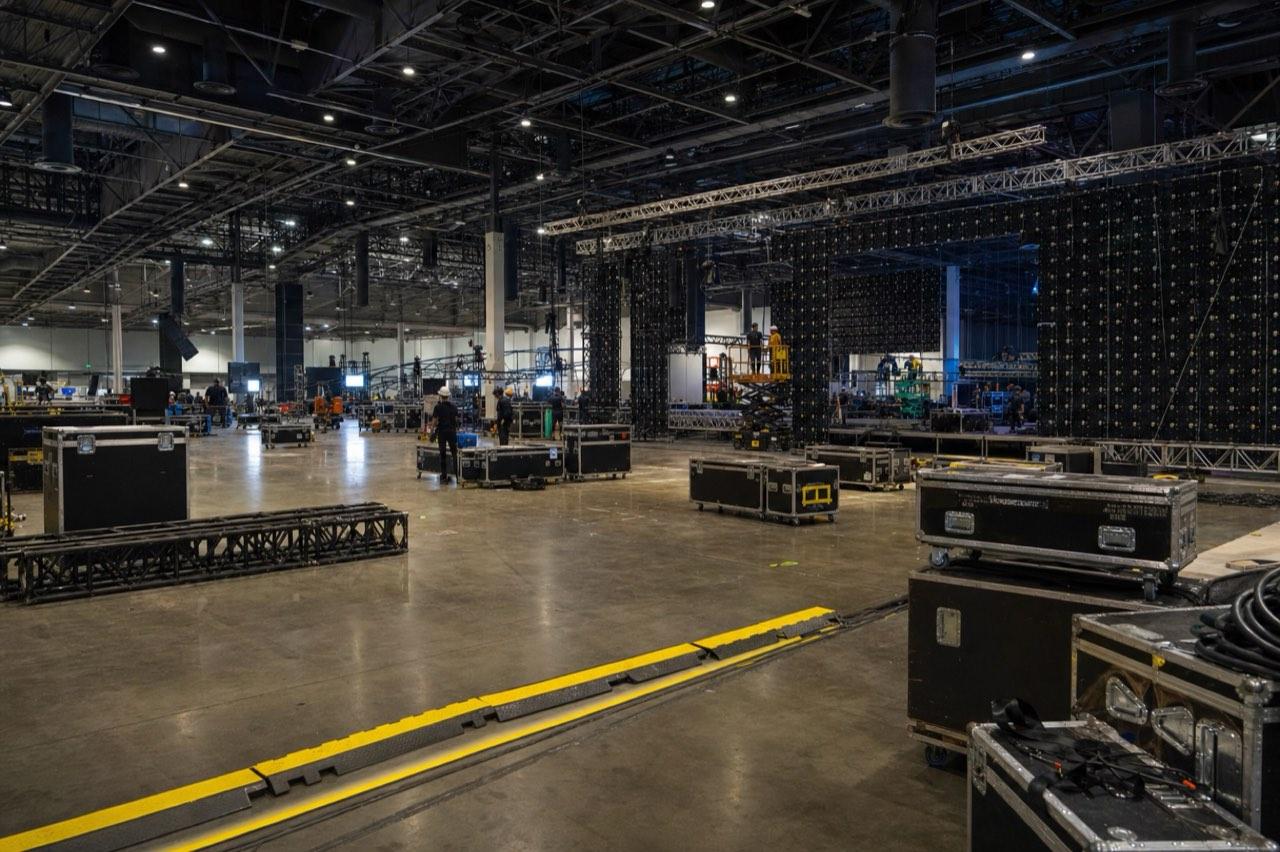
Your build time doesn’t start when the first scenic piece touches the floor. It starts when you have access to the dock and the freight path.
We plan load-in like a warehouse operation:
- Staging zone: where cases land before they go to position
- Traffic lanes: where carts and lifts move without blocking each other
- Sequencing: what must arrive first (power, rigging, structure) vs what can wait (decor, branded props)
If the dock is shared with other events, assume delays. If you have a tight window, pre-label cases by zone and build order so the crew isn’t hunting.
3) structure first: truss, scenic, and any overhead work
If anything is flown, it goes early. You don’t want lifts weaving through finished scenic and installed tech.
Common dependencies:
- Rigging points approved and marked
- Motors/hoists installed and tested
- Truss built on deck, then flown (or grid work completed)
- Scenic walls erected and braced
Overhead work sets the pace for everything underneath. If your plan relies on flying a header at 2:00 AM, ask whether the venue even allows overhead work that late.
4) power distribution: you can’t “just plug it in” later
Power is usually the first real technical decision that affects timeline because it dictates where gear can land.
We’ll typically sequence power like this:
- Tie-in or generator landing (if applicable)
- Main distribution and feeder paths
- Branch circuits to zones
- Final device power drops
The practical note: once scenic and carpet are down, rerouting feeder is slow and messy. Plan feeder paths early, protect them, and keep them accessible for inspection.
build order for AV: signal paths, then endpoints
For brand activations, video surfaces are often the hero. But we still build signal infrastructure before we chase perfection on the last panel.
video: panels, processing, and content playback
A realistic LED or display build has three layers:
- Physical: panels or displays mounted, serviced, and safely supported
- Electrical: power distribution sized correctly, circuits balanced
- Signal: processors, conversion, routing, and redundancy
We’d rather have 80% of the wall online and mapped correctly than spend the first half of the day chasing one corner while nothing else can be tested.
audio: decide whether you need “coverage” or “moments”
Many activations don’t need concert-style coverage. They need targeted sound that doesn’t spill into the aisle.
Define the goal:
- Is audio meant to pull people in from 30 feet away?
- Is it just reinforcing a product demo?
- Is it mostly for staff comms and cues?
Once the objective is clear, you can right-size speakers, placement, and tuning time.
lighting: build for looks, but plan for maintenance access
Lighting in an activation is usually about texture and brand color, but we still plan access:
- Can a tech get to fixtures after scenic is complete?
- Are power supplies and data nodes reachable?
- Is haze allowed (often it isn’t in convention centers)?
If fixtures are buried behind fabric walls with no access panels, any failure becomes a scenic tear-down.
the short checklist we use to keep the schedule honest
This is the quick gut-check list we run before we commit to a build window:
- What tasks require lifts, and when are lifts available?
- What tasks require venue labor (dock, rigging, electrician), and what are their call times?
- What elements depend on final content delivery?
- What can be tested before the full build is complete (playback, networking, control)?
- What can fail without killing the activation (and what can’t)?
If you can’t answer these, the timeline isn’t a timeline yet. It’s a wish.
typical timeline ranges (and why they vary)
Producers always ask for “how long does this take.” The honest answer is: it depends on dependencies, not just square footage.
Here are ranges we see often:
pop-up footprint with minimal tech
If it’s mostly scenic with a couple displays and simple power, builds can be tight. But it’s only tight if access is clean and approvals are done.
mid-size activation with LED, audio moments, and lighting
This is where timelines stretch because multiple departments need the same space at the same time. If the space is constrained, we plan in zones so crews aren’t stacked on top of each other.
large footprint with flown elements, multiple video surfaces, and interactive stations
This is where a realistic schedule includes time for:
- Rigging and inspection
- Network commissioning and device testing
- Full experience walk-throughs
- Contingency for inevitable adjustments
The difference between a smooth build and a painful one is usually whether the schedule included real test time.
the failure modes that blow up build timelines
If you want to protect the schedule, plan around the predictable problems.
late or mismatched content
If the wall is 7680×2160 but content arrives as a last-minute 4K file, somebody is reformatting at the worst possible time. Lock specs early and confirm deliverables, not just “we’ll send content.”
power surprises
We see timelines slip when:
- House power isn’t where the drawing assumed
- Circuits are limited or shared with other events
- Tie-in is scheduled later than the crew call
Power is boring until it’s not. Make it a first-class workstream.
rigging approvals and point changes
If the rigging plot changes on site, you can lose hours. Sometimes the venue grid isn’t what the PDF suggested. Sometimes a point is denied for structural reasons. Build a backup plan that still works if you lose a point or have to move one.
crew congestion
A cramped activation can’t support eight departments working at once. When we see congestion risk, we time-box tasks and move crews in waves.
how we compress timelines without gambling the show
Sometimes you don’t get the window you want. When that happens, we compress by changing scope and increasing parallelism in controlled ways.
simplify the build in the right places
If you’re short on time, these usually buy the most schedule back:
- Reduce flown elements (or make them ground-supported)
- Standardize display orientations and resolutions
- Limit custom scenic that requires onsite fabrication
- Cut interactive stations that need per-device troubleshooting
The goal isn’t to make the activation smaller. It’s to make it buildable.
add labor strategically, not blindly
Throwing bodies at a build can make it slower if it increases congestion. We add labor where it creates parallel work zones:
- A dedicated cable team to keep paths clean
- A dedicated video mapping/operator to manage processors and content
- A dedicated scenic lead who keeps structure moving while tech teams prep
If you can’t split the work into zones, extra crew won’t help.
prebuild and preconfigure
The best compression is work done before you hit the dock:
- Pre-assemble scenic modules
- Pre-label every cable and power run
- Preconfigure media servers, processors, and control
- Build a “known good” show file and keep a backup copy onsite
This is how you turn onsite time into mostly assembly and verification. Printed and branded elements follow the same rule: a floor graphic has a print clock that starts at artwork approval (see branded dance floor vinyl wraps for corporate events), and a photo booth needs its overlay artwork and sponsor approvals early (see photo booths for corporate events).
plan the handoff: who owns the activation at doors
Your timeline should include a clean handoff from build to operations. That means:
- Who’s on headset for opens
- Who has authority to make changes (and who doesn’t)
- What issues are “fix now” vs “log and live with it”
- Where spare parts live (power supplies, data nodes, adapters)
The handoff is also where you protect the client relationship. If the activation is operationally owned, you stop last-minute “can you just” requests from ripping apart the build.
what we ask clients for upfront to keep builds predictable
If you want a predictable schedule, the producer has to pull information forward. We ask for:
- Final renders with dimensions
- A list of must-have brand moments (and what can flex)
- Content specs and delivery dates
- Staffing expectations for brand reps onsite
- Any restrictions on sound, haze, rigging, or floor protection
When we have those answers, we can call the schedule with confidence and build in contingency where it matters.
the reality check: if the timeline is tight, decide what “good” looks like
The real question isn’t “can we do it.” It’s “can we do it and have it look intentional.”
If your build window is compressed, pick your definition of success:
- Perfect visuals, simplified interactivity
- Full interactivity, simplified scenic
- Minimal changeover risk, fewer moving parts
There’s no shame in trading complexity for reliability. In corporate and brand environments, the audience rarely knows what you cut — they only notice what breaks.
close the loop with a timeline you can defend
Once you’ve built the plan, write it down as a sequence with owners, dependencies, and a clear “build complete” definition. Then pressure-test it:
- What happens if dock access is 60 minutes late?
- What happens if a point is denied?
- What happens if content is delivered wrong?
If the plan survives those questions, it’s probably realistic.
If you want EventProSource to spec the build plan and staffing for your brand activation, we can build a plan that covers primary show flow, backup options, and the operational handoff at doors. Email hello@eventprosource.com for a 24-hour quote and a practical recommendation based on your run of show.