Photo Booth for Corporate Events: Formats and Branding
How to choose, brand and brief a corporate photo booth: open-air, enclosed and 360 formats, footprints, power, sharing, email capture and queue capacity.
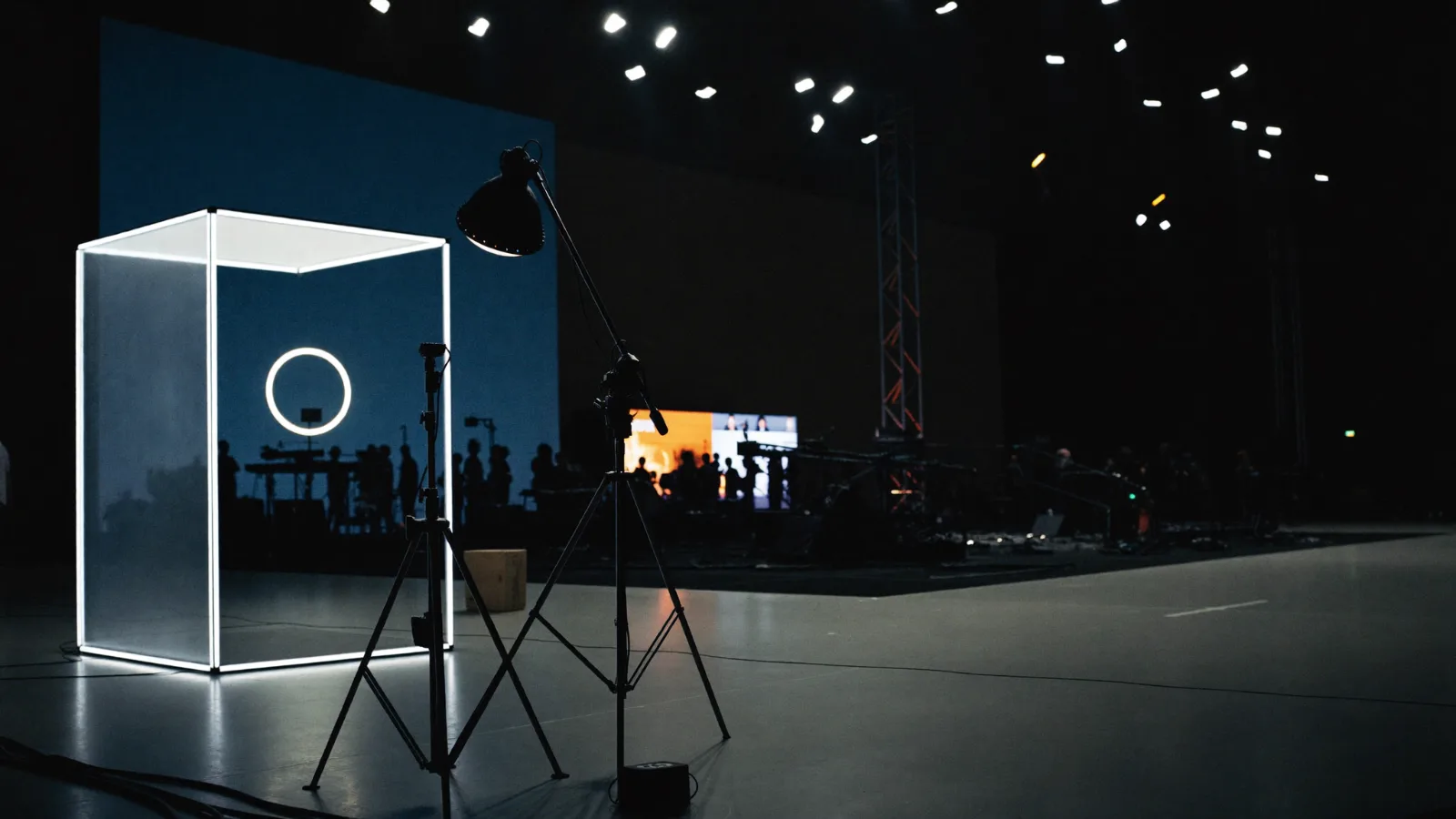
A sponsor, a CMO or a client lead says "let's add a photo booth," and the planner is left with the production questions. Where does it go? What does it plug into? Who runs it? What is it for? A booth dropped in as a party add-on turns into a queue in the lobby with a generic overlay and no follow-up. A booth planned as part of the room produces branded content and, where guests consent, a contact list.
This guide is written the way a production manager would brief it: pick the format, size the footprint, brand it so it reads on a phone, plan the sharing and data, then write the brief. Every spec below comes from the EventProSource photo booth rental page unless it is labeled as production judgment or our planning assumption.
What does a photo booth do at a corporate event?
A corporate photo booth is a branded capture station, open-air, enclosed or 360 video, staffed by an attendant, that turns guests into shareable photos, GIFs or video clips and, where consent is collected, into a contact list for follow-up.
Per the service page, it does three jobs:
- Guest engagement. It gives people something to do between sessions, at a reception or in a sponsor area.
- Social amplification. Branded overlays carry the event name and sponsor logos into every photo or clip a guest shares.
- Email capture and analytics. An optional capture screen with consent language collects addresses, and the delivery report covers session count, output format mix and share rate.
It does not replace a registration desk, and it is not a lead-scanning system. Guests use it voluntarily, so treat the contact list as a bonus, not as your attendee data. The difference from a wedding booth is the brief: a wedding booth serves guests and keepsakes, a corporate booth serves a brand goal and has to be approved by people who own logos, guidelines and data policies.
Which format fits: open-air, enclosed or 360?
The service page lists four booth types. The footprints below are the page's figures. The "what it suits" column is our production judgment, not a rule.
| Format | Footprint (service page) | What it suits (our judgment) |
|---|---|---|
| Open-air | 8 ft by 8 ft including prop table space | Lobbies and sponsor areas where a backdrop frames the shot and people can watch |
| Enclosed | 6 ft by 6 ft | Tight corners and corridors where floor space is the constraint |
| 360 video | 10 ft by 10 ft for safe operation | Launches and activations where the video clip is the content |
| Roamer | No fixed footprint; a roaming mirrorless camera setup | Cocktail hours and floor coverage when a fixed station would stall traffic |
Outputs include prints, GIFs, Boomerangs and video clips. The page quotes print speed at under 8 seconds per print.
Pick by goal first and by room second:
- Engagement in a crowded room: open-air, because onlookers see the booth in use and the line is easy to read.
- Social reach: 360 video or GIF output, because a moving clip gives guests something to post. That is our judgment, not a measured claim. The analytics report after the event shows which formats were actually shared.
- Broad coverage of a large floor: a roamer, or a roamer alongside one fixed booth.
- A booth that must fit a hallway or a corner: enclosed.
If the activation is a larger interactive build, the booth is usually one element inside it. In that case look at experiential marketing production so the booth, the content and the traffic flow are designed together.
How should the booth be branded?
The service page names three layers, and they can be used alone or together:
- Digital overlay. The frame on every photo, GIF or clip. It carries the event name, date and sponsor logos.
- Physical backdrop. What stands behind the guest. Custom backdrop fabrication is a scope item, a simple digital overlay is not.
- Booth wrap. Branding applied to the booth itself.
A few rules we use when reviewing branding for a booth:
- One color source. Pull the palette from the event lockup, not from three different sponsor decks.
- Design for phone size. Guests share to their phones, so keep the overlay clean, with the logo lockup in one corner and the rest of the frame clear for faces.
- Match the room. If the event runs an LED wall, take color and type treatment from the content already on it so the booth does not look like it came from a different event.
- Get sponsor approvals early. Logo approval is a client-side task, and in our judgment it is the step to start first. Collect final files and written approvals before you send artwork for the overlay.
For a booth inside a broader brand build, brand activation production covers the design and fabrication side, and our post on brand activation build timelines explains how to back-schedule artwork, fabrication and install.
What do space, power and placement require?
Per the service page, setup takes 45 to 90 minutes, the booth runs on standard 20A, 110V power, and it is tested with live branding before the event opens. Power and Wi-Fi requirements are confirmed with the venue in advance.
Placement is where booths tend to go wrong. This is production judgment, not a spec:
- Off the registration path. A queue that backs into the door is the failure to design out. Give the booth its own approach.
- Away from the loudest speaker. Attendants talk guests through the session, and audio from a nearby PA makes that hard.
- Controlled light behind and around the guest. Window light or LED spill from a nearby screen washes out the subject. If the booth sits near a video wall, check how it lights faces.
- Visible from the room. People join a line they can see moving.
- Clearance for the 360 arm. The page calls for 10 ft by 10 ft for safe operation. Mark that circle on the floor plan, not just the booth's own footprint.
Ask the venue for four things before you commit to a position: the location of the power drop, the load-in time, the freight route to the booth position, and a floor plan with the footprint drawn on it. If the booth shares a circuit with other gear, our guide to event power distribution explains how loads are split. On a show floor, the constraints change, and trade show booth A/V covers what to expect there.
How do sharing, galleries and email capture work?
The service page lists the delivery routes: SMS, email, AirDrop and a QR code to a live gallery. Printed copies are an option. Instant SMS and email delivery are standard.
Anything that sends or loads live needs connectivity. Guest Wi-Fi in a ballroom is shared by every phone in the room, so ask the venue for a production-grade connection for the booth, or plan an alternative. Our post on event Wi-Fi versus bonded cellular explains the trade-offs.
If you want email capture, the platform includes an optional screen with consent language. Two things to settle before the event:
- Who approves the consent wording. Your privacy or legal team should approve the language and how the addresses will be used afterward. We do not give legal advice, and this guide makes no claim about any law.
- Who receives the data. Per the service page, data exports go to the client within 24 hours after the event ends.
After the event, the full digital gallery and the analytics report are delivered to the client within 24 hours, with files in full resolution. That is a post-event delivery detail, separate from how fast a quote comes back.
If you want the live gallery visible in the room, a screen above the booth is one option. See TV and monitor rental for screen options.
How many guests can one booth serve?
The service page says an on-site attendant is included. The attendant manages the booth, assists guests, replaces paper and consumables and troubleshoots technical issues. Here is the capacity arithmetic we use, and it is our planning assumption, not a measured rate:
- Assume one session takes about two minutes, including the guest swap.
- That is about 30 sessions an hour from one booth.
- A two-hour window gives about 60 sessions.
Now compare that to your headcount. At 300 guests, a single booth over two hours cannot reach everyone, and most guests will skip it anyway. So decide what the booth is for. If it is a core activity, such as a sponsor activation, add a second booth or a roamer. If it is a bonus for people who want it, one booth with a clear sign and a visible line is enough. The mistake is promising a sponsor broad reach from one booth in a short window.
Longer duration affects attendant labor and consumables, which is why hours of operation show up in the cost drivers below.
What goes in the brief, and how does the quote work?
Send the brief once and complete. Here is the checklist:
- Venue and room name
- Booth area dimensions and the location of power
- Event date, doors time and the hours the booth should run
- Goal: engagement, social reach or lead capture
- Format: open-air, enclosed, 360 video or roamer
- Output: prints, GIFs, video clips or a QR gallery
- Branding files, sponsor logos and the name of the person who approves them
- Consent and data needs, and who owns the follow-up list
- Expected attendance
On cost: Pricing scales with pixel pitch, square footage, install complexity, labor, duration, and content needs. We return a fully itemized quote within 24 hours of brief. For a photo booth the drivers are booth type, print quantity, branding complexity, duration and add-ons such as GIF stations or roaming camera operators.
We source vetted local crews and gear per metro, whether that is New York, New Jersey, Connecticut or Massachusetts, and spec the booth to the room instead of defaulting to whatever is on a shelf. Ready to scope it? Request an itemized quote with the checklist above. We return a fully itemized quote within 24 hours of brief.
Frequently asked
Per the EventProSource photo booth page, an open-air booth needs about 8 ft by 8 ft including prop table space, an enclosed booth needs 6 ft by 6 ft, and a 360 video booth needs 10 ft by 10 ft for safe operation. Confirm each against the venue floor plan before you lock a position.
Yes. Per the service page, every photo booth package includes an on-site attendant who manages the booth, assists guests, replaces paper and consumables, and troubleshoots technical issues for the length of the event.
Yes. The platform includes an optional email capture screen with consent language, and data exports go to the client within 24 hours after the event. Your privacy or legal team should approve the consent wording and how the list will be used.
Yes. Logo, event name, color palette and custom artwork can go on the digital overlay, the physical backdrop and the booth wrap. Collect final logo files and written sponsor approvals before artwork is sent.
Per the service page, setup takes 45 to 90 minutes. The booth is tested with live branding before the event opens, and power and Wi-Fi requirements are confirmed with the venue in advance.