Branded Dance Floor Vinyl Wraps for Corporate Events
How to spec a dance floor vinyl wrap for a corporate event: size, artwork, lead time, venue approval, install and strike, and what to put in the brief.
You have an LED wall behind the stage, a lockup on the podium and a step-and-repeat at the door. Then guests walk in and the largest open surface in the room is a bare dance floor. It sits in every wide photo and every shot from the balcony, and it carries nothing.
A branded floor fixes that, but only if the decisions are made in the right order. Size, artwork, venue approval and the install slot each have a deadline, and the print step can only be shortened with a rush line on the quote. This guide lays out the spec the way a production manager would hand it to a planner.
What is a dance floor vinyl wrap, and when does a corporate event use one?
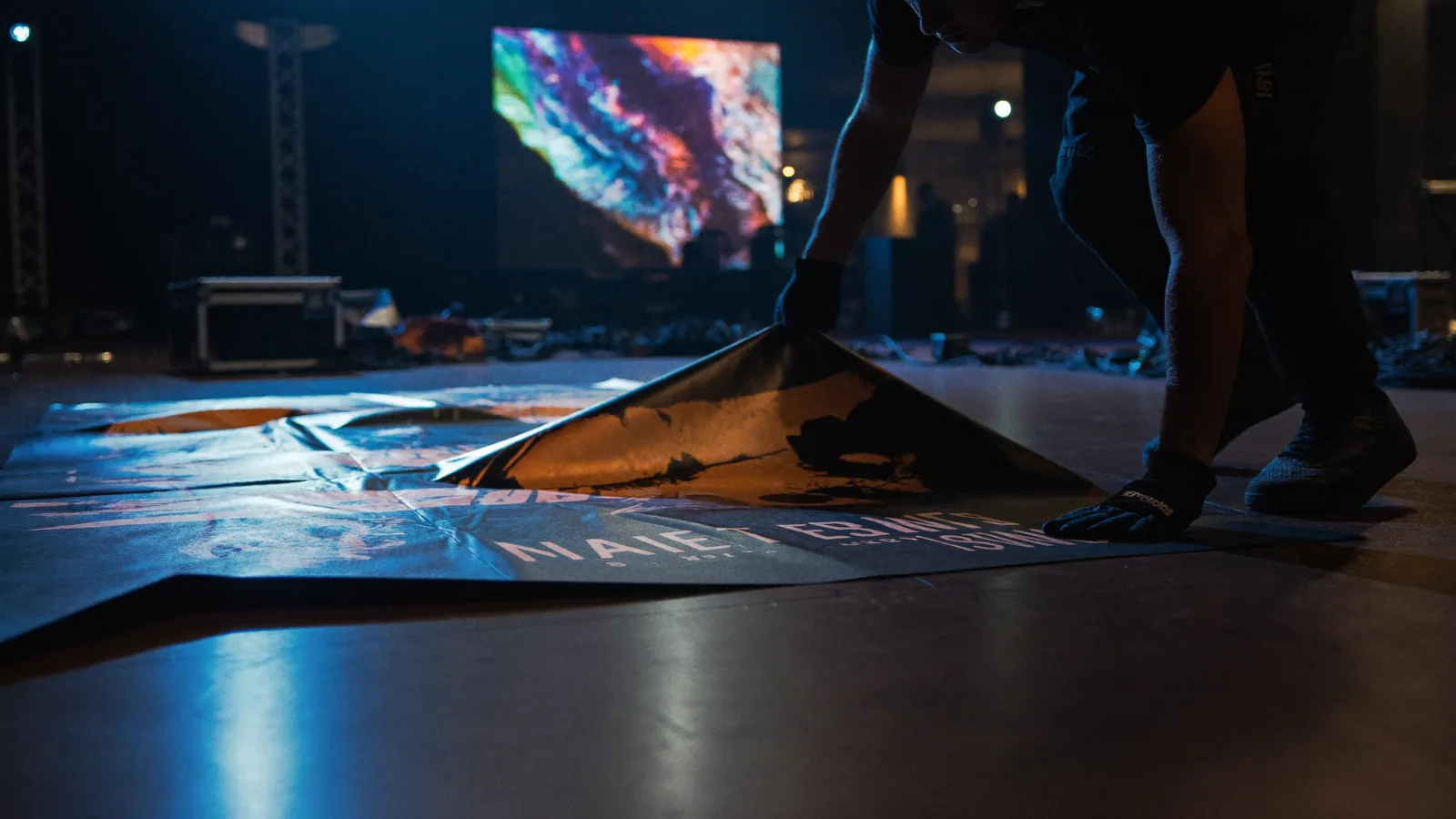
A dance floor vinyl wrap is a custom-printed, non-slip vinyl graphic cut to the dimensions of the floor and laid over a portable dance floor or the venue floor for the length of the event, then peeled off afterward. Our dance floor vinyl wraps service covers the print, the install and the removal.
Corporate teams book one for four jobs:
- Awards night or closing party. The logo, event lockup or awards year carries from the LED wall and stage graphics down onto the floor, so the room reads as one design.
- Product launch. The floor becomes part of the brand environment instead of a neutral gap between the stage and the bar.
- Activation. A photo-forward floor gives attendees something to shoot and share. This is where brand activation production and the floor are specced together.
- Gala or fundraiser. The floor can carry the organization's mark, the event year or a donor recognition treatment, matched to the stage look and the step-and-repeat.
Monogram floors are common at weddings. A corporate floor is a different brief: it extends an existing room design and has to match approved brand files.
How big should the dance floor wrap be?
Size the wrap from the floor, not from the logo. The floor size comes from how many people will dance at once and how much room the stage, bar and tables leave. The wrap is then cut to the floor's exact dimensions. If the stage and floor are competing for the same footprint, settle that first; our note on right-sizing the stage covers it.
Per the specifications on our dance floor vinyl wraps service page, standard sizes are 12x12, 16x16, 20x20, 24x24 and 30x30 feet. A single wrap goes up to 50x50 feet. Anything larger is tiled with matched seams that are visible only up close. Circles, T-shaped runways and other cutouts are available with custom cutting.
The capacity column below is our planning assumption, not an industry standard: 4 to 5 square feet per person who is dancing at that moment. Only a share of a room dances at once, so a floor sized this way does not need to hold your whole headcount.
| Floor size | Area | Dancing at once (planning assumption) | Typical use |
|---|---|---|---|
| 12x12 ft | 144 sq ft | about 29 to 36 | VIP lounge, small activation floor |
| 16x16 ft | 256 sq ft | about 51 to 64 | Small closing party, launch reception |
| 20x20 ft | 400 sq ft | about 80 to 100 | Awards after-party, product launch |
| 24x24 ft | 576 sq ft | about 115 to 144 | Mid-size gala |
| 30x30 ft | 900 sq ft | about 180 to 225 | Large gala, conference closing night |
Worked example: a 20x20 floor is 400 square feet. At 4 to 5 square feet per dancer, that is 80 to 100 people on the floor at the same moment, which suits an awards after-party of several hundred guests.
How do you design the floor to match the room?
Treat the floor as the third surface after the LED wall and the stage. These points keep the three consistent:
- One color source. Pull the floor colors from the same brand file the LED wall content uses. Printed vinyl is CMYK and an LED panel emits light, so expect the two to differ. Per the service page, Pantone spot-matching is available on request for brand-critical colors. It adds a print-prep step, so ask early.
- Content resolution is set on the LED side. If the floor graphic repeats a wall element, build both from the same source file. Our guide to LED wall content resolution covers pixel mapping and aspect ratios.
- Finish. Wraps print in a matte or satin finish (service page), which helps limit glare back toward the cameras when the stage lighting comes up. Ask the lighting designer whether a gobo wash or moving-head pattern will land on the floor, because a busy graphic under a busy pattern reads as noise. The warm and cool gala lighting post explains how color temperature changes what a printed color looks like in the room.
- Seams. A wrap larger than one printed panel has seams. Keep text and small logos away from them. The mockup should have the seams marked before you approve it.
- Camera and stream. From a balcony or a camera on a jib, fine detail disappears. A large, simple mark and a strong border read from every angle.
What artwork files and lead time does a wrap need?
Vector files (AI, EPS or PDF) are ideal. High-resolution raster files at 300 DPI at final size, in TIFF or PNG, also work. If you only have a low-resolution file or a sketch, the wrap can be built into print-ready art from that starting point, and the design can be produced from a brief. The service page lists print resolution as 1200 DPI.
Per the same service page specifications, standard turnaround is 10 to 14 business days from final artwork approval. Rush turnaround is 5 to 7 business days and carries a rush fee. Complex designs and Pantone matching add a couple of days on the prep side. Ten to fourteen business days is two to three calendar weeks, and that clock starts at approval, not at the first draft.
Here is a back-schedule from event day. The print turnaround is the figure above. The other lead times are our planning assumptions, built to leave a one-week buffer for the delivery of the roll and any revision.
| When (counted back from event day) | What gets locked |
|---|---|
| 5 weeks out | Venue gives written approval for the floor adhesive; floor type confirmed |
| 4 weeks out | Final artwork approved after the mockup with seams marked; print clock starts |
| 1 to 2 weeks out | Wrap printed, cut and rolled |
| 1 week out | Install slot placed on the load-in schedule; freight and receiving confirmed |
| Event morning | Install |
| After the last event night | Strike |
A rush order shrinks the middle of that table, not the ends. The venue approval and the artwork sign-off still have to happen first. For a wider view of how approvals and load-in windows stack up on a build, see brand activation build timelines.
What should you ask the venue before you book?
The venue controls the floor. Get these answers in writing before artwork is approved:
- Does the venue approve a low-tack, removable floor adhesive on this floor? Who signs?
- What is the floor: hardwood, portable dance floor, sealed concrete or vinyl? Per the service page, installs have been done on all four. Sensitive floors get a compatibility test in an inconspicuous spot first.
- Is the surface clean and dry at the install time? A clean, dry floor is required.
- Where is the freight elevator or dock, and what is the window for it?
- Who receives the rolled wrap, and where is it staged until install?
- Are there house labor or install-hour rules that affect the floor slot?
- Will the venue's floor be down before the wrap crew arrives, or is the portable floor part of our scope?
There are two routes. On the venue-floor route, the wrap goes straight onto the existing floor. On the portable-floor route, we source a portable dance floor and a crew local to the metro, and the wrap is pre-installed for a single delivery. A portable floor is usually cleaner to prep than a shared hardwood floor, which is why the second route is common when the venue floor is uncertain.
If a DJ or band is on the program, tell the DJ and dance floor setup team where the booth sits before the artwork is final. The same position goes into the brief below.
How does install, show day and strike work?
Per the service page, install usually happens the morning of the event. A 20x20 floor takes about 60 to 75 minutes, and a 30x30 floor with tiled seams takes 90 to 120 minutes. An installer stays on site through the install to check seams and edges.
Where it goes on the schedule matters more than the minutes. Put it after the floor is laid and before lighting focus and the guest-facing room set, so no one is walking on a half-applied wrap or focusing around a floor that is still being laid.
The service page describes the vinyl as spill-resistant, with standard event spills wiping clean. If a large volume of liquid sits on a seam for a long time, it can migrate under, so have staff wipe seam spills quickly.
Per the service page, removal is faster than install, usually 30 to 45 minutes. The wrap is peeled and disposed of, and nothing stays on the floor. The vinyl is a single-install material: once peeled, it does not reinstall cleanly, so a recurring event reprints the same size and design. For a multi-day program, schedule a strike and a new install between event nights.
What goes in the brief, and how does the quote work?
Send these with the request:
- Venue and floor type
- Floor dimensions, or the headcount and layout so the floor can be sized
- Event date and load-in time
- Artwork files or a brand guide
- Finish, matte or satin
- Pantone colors that must match
- Single day or multi-day, and whether the wrap changes between nights
- Freight access and the contact who receives the roll
- Position of the stage and the DJ booth, so no key graphic ends up under a riser or a table
Pricing scales with pixel pitch, square footage, install complexity, labor, duration, and content needs. We return a fully itemized quote within 24 hours of brief.
For a dance floor wrap, the drivers are floor size, design complexity, rush turnaround, color matching, multi-day wrap and strike, venue access, and removal complexity.
To start, request an itemized quote with the venue, the date and the floor size. We source vetted local crews and the right gear for each metro we cover in New York, New Jersey, Connecticut and Massachusetts, so the spec follows the floor you have rather than whatever is available.
Frequently asked
Wraps are printed on non-slip, event-grade vinyl with a matte or satin finish. Before you approve the material, ask for its slip data in writing, and share it with the venue if they ask. Keep the floor clean and dry at install, and wipe spills quickly, especially near seams.
The adhesive is low-tack, floor-safe and removable without residue, and installs have been done on hardwood, portable dance floors, sealed concrete and vinyl. Sensitive floors get a compatibility test in an inconspicuous spot first. Still get the venue's approval in writing before artwork is locked.
Standard turnaround is 10 to 14 business days from final artwork approval, which is two to three calendar weeks. Rush turnaround of 5 to 7 business days is available with a rush fee. Venue approval and the mockup with seams marked have to happen before that clock starts.
No. The vinyl is a single-install material and does not reinstall cleanly once it has been peeled. If you run a recurring event with the same floor size and design, the wrap can be reprinted for each instance.
Size it from the room and the number of people dancing at once, not the whole headcount. Our planning assumption is 4 to 5 square feet per dancer, so a 20x20 foot floor holds roughly 80 to 100 people at once. Standard sizes run from 12x12 to 30x30 feet.