Stage Monitor Mixing for Live Bands at Corporate Events
Monitor mixes decide whether a corporate band feels easy or fights the stage. Here’s how we plan wedges, IEMs, and comms so it stays clean.
why stage monitors are the make-or-break layer
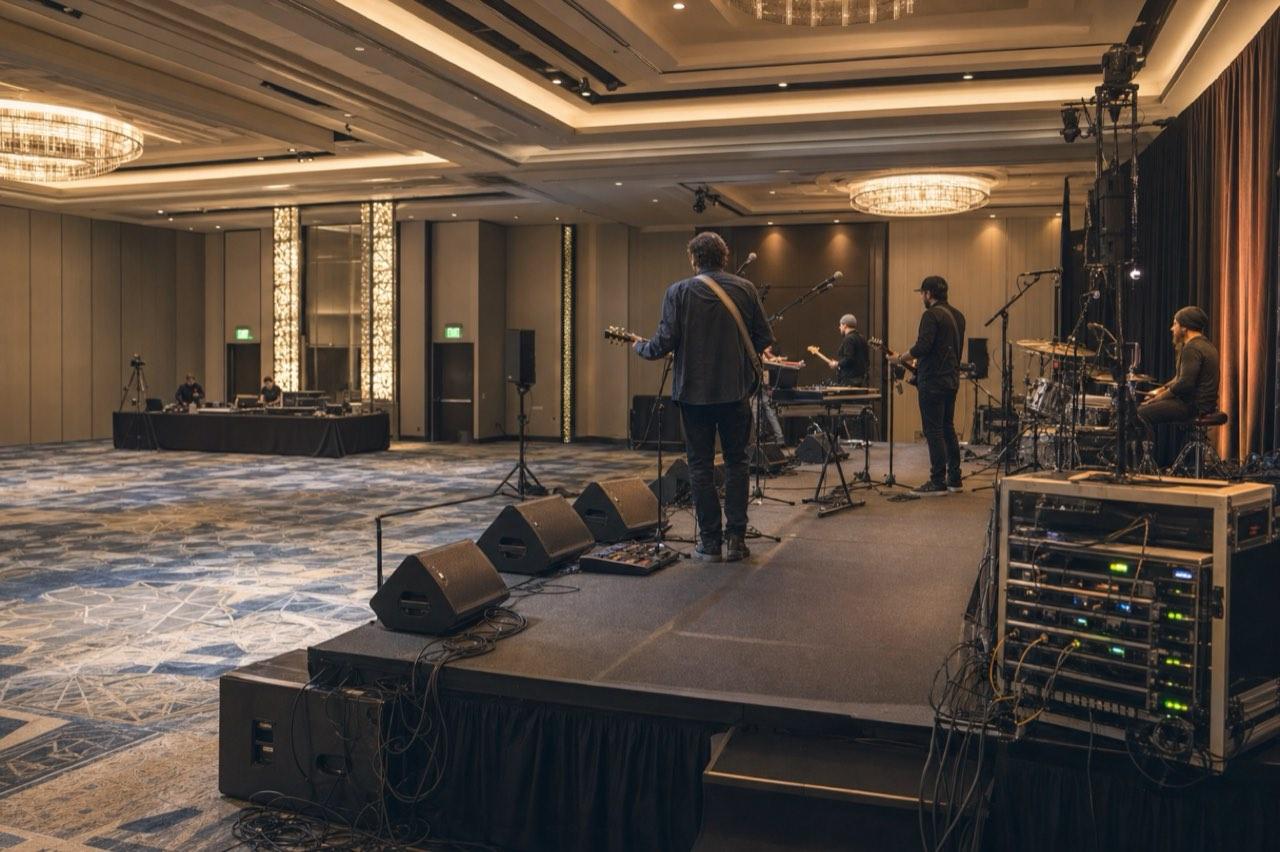
A corporate ballroom show can look calm from the audience, but the stage is a small, loud workplace. The band is reacting to what they hear in real time. If the monitor world is unstable, you’ll see it fast: singers drift sharp, the drummer plays harder, the MD starts waving at FOH, and your run-of-show absorbs the stress.
We treat monitors like a separate “show inside the show.” The goal isn’t to make the stage quiet. The goal is to make it predictable.
start with the inputs, not the wedges
Before we talk about wedge count or IEM channels, we start with a clean input list. Corporate bands are often flexible lineups, and that’s where issues show up.
We ask for:
- An input list (including playback, click, talkback, and guest mics)
- A stage plot with positions and risers
- A monitor mix list (who needs what, and whether it’s wedges or IEM)
- Any “hard rules” (no wedges for lead vocal, drummer must have stereo IEM, etc.)
If you skip this step, you end up building a monitor plan around assumptions. Assumptions become last-minute patch changes, and last-minute patch changes are where mistakes happen.
choose wedges vs iems based on the room, not preference
A lot of people frame this as taste: “Some bands like wedges, some like IEMs.” That’s true, but in corporate work the room drives the decision.
Wedges make sense when:
- The stage is wide enough for proper spacing (no wedges stacked on top of each other)
- Volume on stage won’t spill into podium mics or audience seating
- The band is comfortable with shared acoustic space
IEMs make sense when:
- You need tighter SPL control (especially with corporate speech segments)
- The room is reflective and wedges become feedback-prone
- You have a video record or stream and want clean vocal mics
A common hybrid that works well: wedges for backline players, IEM for lead vocal, and a dedicated “more-me” path for the singer.
plan monitor world like a small network
Monitor world isn’t just speakers. It’s a set of paths that need to survive change.
At minimum, we plan:
- Console outputs (auxes, matrices, or dedicated monitor sends)
- Amp channels (for passive wedges) or power distro (for active wedges)
- IEM transmitters and antenna layout
- Talkback and cue paths
- Spare outputs and spare packs
If you’re mixing monitors from FOH, this planning matters even more because you won’t have the time or the physical access to troubleshoot on stage during the set.
output count: write it down early
Producers get surprised by monitor output counts because the band’s needs expand once you include the “invisible” channels.
Here’s a realistic corporate band monitor map:
- Lead vocal: stereo IEM (2 outputs)
- BGV: wedge or mono IEM (1 output)
- Guitar: wedge (1 output)
- Bass: wedge or IEM (1 output)
- Keys: wedge or IEM (1 output)
- Drummer: stereo IEM (2 outputs)
- Playback/click: split to drummer and MD (often embedded in those stereo mixes)
- Tech talkback: stage to FOH and FOH to stage (routing, not always extra outputs)
That’s already 8–10 monitor sends depending on how you build it. If you want separate mixes for each musician plus sidefills, you’re easily at 12–16.
wedge deployment: fewer, cleaner, and aimed correctly
More wedges rarely fixes a monitor problem. It usually creates one.
We’d rather deploy fewer wedges and place them with intent:
- Aim at ears, not knees. Wedges sitting too far forward turn into stage fill, not monitoring.
- Keep wedges off mic rear lobes. If the vocal mic is pointing into the wedge, you’re building a feedback loop.
- Avoid wedge “piles.” Two wedges stacked near a mic position is a common corporate compromise, and it’s a messy one.
If the band needs more low end in wedges, we decide whether to provide it or move them to IEM. Low end in wedges can be workable, but it’s where the room talks back.
iem planning: rf and antenna choices matter
IEMs solve some problems, but they introduce a different set: RF management and failure behavior.
We plan IEM like a short RF deployment:
- Put transmitters in a clean rack with proper power and ventilation
- Use paddle antennas or a combiner when multiple transmitters are in play
- Get antennas above stage height when possible, with line of sight
- Keep transmit antennas away from Wi‑Fi APs and LED processors when you can
When IEM fails, it fails hard. A wedge can get “kind of okay” even when the mix is wrong. An IEM drop-out is instantly distracting.
talkback is not optional in corporate shows
Corporate bands often have cues, walk-ons, and a hard stop at a specific time. If the band can’t hear the show caller, you’re back to hand signals and hope.
We build talkback so it’s usable and doesn’t leak:
- FOH talkback mic to selected monitor mixes (usually MD and drummer first)
- Stage talkback mic back to FOH (so the band can ask for changes)
- If there’s a stage manager, a comm path that doesn’t depend on shouting
Talkback should be easy to mute. Nothing will sour a room faster than a private cue coming through the PA.
the one short checklist we use before doors
Before doors, we run a quick reality check. It’s short on purpose.
- Confirm every wedge is on the right output and labeled
- Verify IEM packs are assigned and have fresh batteries
- Line-check talkback both directions
- Ring out vocal wedges at show volume (not at whisper level)
- Save a console scene once monitors are stable
This is where you catch the “monitor 3 is actually monitor 5” problem while it’s still easy.
ring out without wasting your rehearsal
“Ringing out monitors” can turn into a time sink. In corporate schedules, you don’t have 45 minutes to chase every narrow squeal.
We ring out with constraints:
- Start with vocal wedges only
- Set the mic and wedge geometry first (move the wedge before you carve 12 EQ notches)
- Use high-pass filtering aggressively on vocal channels
- Only cut what you can reproduce consistently
If the band needs loud wedges in a reflective room, we’ll have the wedge conversation again. Sometimes it’s not a mixing issue. It’s a physics issue.
managing stage volume so FOH can do its job
Monitor mixing is tied to FOH results. When stage volume climbs, FOH becomes damage control.
We manage stage volume by:
- Keeping guitar amps turned across stage, not straight out
- Using drum shields only when they’re planned well (bad shields sound worse)
- Moving wedges closer to musicians so they can run lower level
- Putting the loudest sources on the side away from podiums and lecterns
A corporate show often has a podium mic that must stay open for a walk-up moment. That mic will hear your entire stage if you don’t plan around it.
failure modes: plan for the boring problems
The issues that hit corporate bands are usually not exotic.
Common failures we plan around:
- Dead DI or a bad 1/4" cable
- Wireless pack with dying batteries
- IEM pack volume knob bumped
- Wedge amp channel clipped because someone pushed too hard
- An extra guest mic added five minutes before the set
We keep spares staged and we keep the patching simple. If a guest vocalist shows up, we want to add one input and one monitor send without reworking the entire board.
mixing monitors from FOH vs having a dedicated monitor engineer
Not every corporate budget supports a dedicated monitor engineer. We make the call based on complexity.
FOH mixing monitors can work when:
- It’s a small band with a stable set list
- Monitor needs are simple (a few wedges, one IEM)
- You have a long soundcheck window
A dedicated monitor position is worth it when:
- The band has multiple IEM mixes and click/playback routing
- You expect guest talent or walk-ons
- The room is feedback-prone and changes need to be fast
Even if monitors are mixed from FOH, we still treat “monitor world” as its own system with labeled outputs and a plan.
what we want from you to lock this in early
If you’re producing a corporate event with live music, the best monitor outcomes happen when we get a few details early.
Send:
- The latest stage plot and input list
- Whether the band is wedges, IEM, or hybrid
- Any hard schedule constraints (short soundcheck, no access after doors, etc.)
- Whether there are speeches that share the same stage
We’ll spec the right number of sends, build a patch that’s easy to adjust, and keep the stage comfortable without letting it run the room.
closing thought and next step
If you’re planning a corporate band and want the monitor world to be predictable, we can help you spec it and run it with the right console, RF plan, and crew. Email hello@eventprosource.com for a 24-hour quote, and we’ll turn around a monitor and FOH plan that fits your room, schedule, and talent.