Wireless Microphone Frequency Coordination in NYC
In NYC, clean wireless mics don’t happen by luck. Here’s how to coordinate RF so your panel, keynote, and Q&A stay clear in a crowded spectrum.
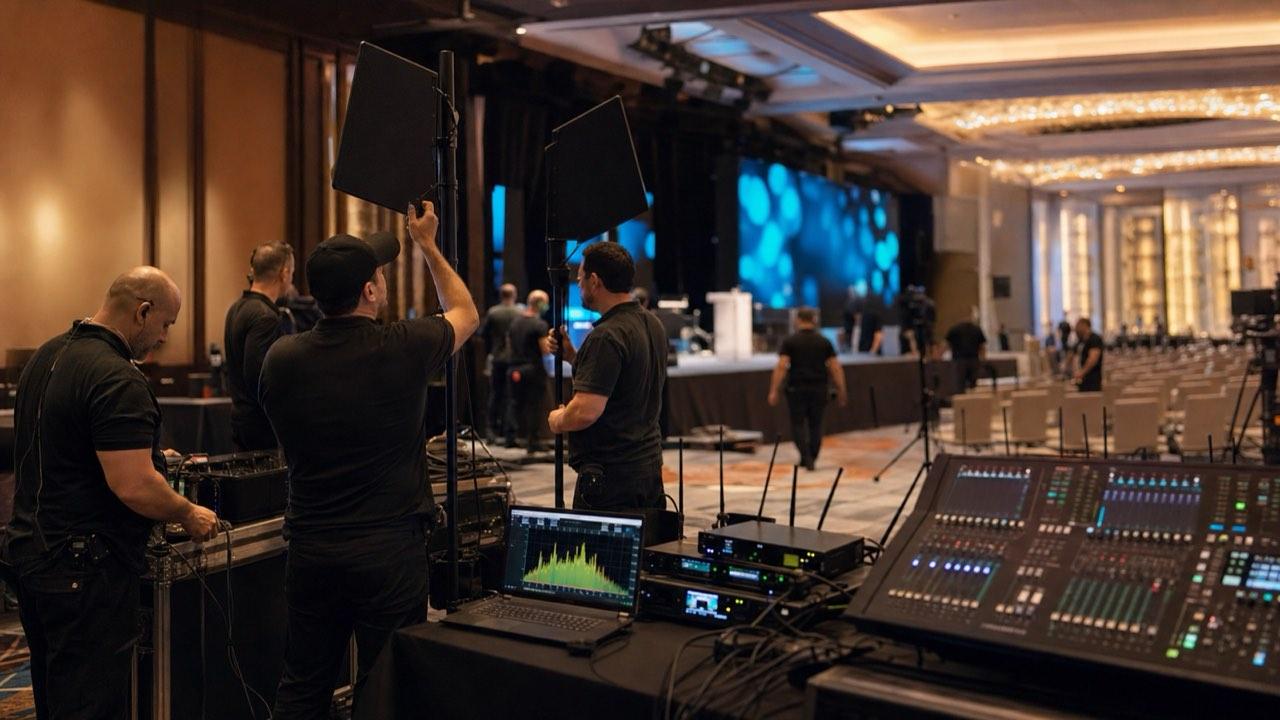
In New York City, wireless mics fail in very predictable ways: a panelist’s lav starts to spit, a handheld gets crunchy when the crowd stands up, or a lectern mic drops out right as the CEO steps up. It’s not bad luck. It’s RF in a crowded market, plus small setup choices that stack up fast. If you’re running a corporate program in Manhattan, Brooklyn, or Jersey City with more than a couple wireless channels, you need a plan that starts before load-in and keeps running until strike.
What makes NYC RF harder than most markets
NYC has a dense mix of broadcast TV, ENG crews, in-building RF systems, two-way radios, and a lot of venues with their own wireless infrastructure. Add high-rise reflections, LED walls, and a ballroom full of cell phones, and you get a spectrum that’s busy and constantly changing.
Two practical takeaways:
- What worked last month in the same room might not work today.
- “Set it and forget it” frequency coordination is how you end up chasing hits during doors.
If you’re used to smaller markets where you can pick a block, spread channels out, and call it done, NYC will teach you quickly that coordination is a workflow, not a one-time choice.
Start with the show requirements, not the gear list
Frequency coordination starts with a clean count and a realistic understanding of what has to be wireless. Before anyone pulls cases, lock these details:
- How many total channels, and what types (lav, handheld, headset, IEM, IFB)
- Who is critical (CEO lav, MC handheld, translator feeds)
- Where talent will actually stand and move (stage only, stage + aisle, audience rovers)
- Any “pop-up” sources (press mics, house handhelds, DJ, band, video playback)
- Whether the venue has existing wireless you must share space with
This is also where you decide if anything should be hardwired. A lectern mic on a gooseneck XLR is not glamorous, but it’s stable, and it takes one wireless channel off the table. Same for a podium feed to broadcast, or a Q&A mic that can be cabled at a fixed position.
For broader audio planning context, it’s worth reviewing your overall checklist and comms plan, especially in NYC rooms with tight schedules. The checklist approach in /blog/corporate-av-checklist-nyc pairs well with RF coordination because it forces you to confirm counts and responsibilities early.
Pre-coordination: use the right inputs
Good coordination depends on having realistic inputs. That means you don’t just coordinate “12 channels in the abstract.” You coordinate 12 channels in this building, today, with this gear, with these antennas, with these power levels.
If you’re coordinating offsite before load-in, use:
- The exact model family (because tuning ranges matter)
- A current TV database snapshot for the NYC market
- Known protected channels (venue comms, in-house mics, assistive listening)
Then treat that as a starting point, not the final answer. The real work happens when you get in the room and scan.
Scanning the room: when, where, and how
The biggest mistake we see is scanning at the wrong time or scanning from the wrong place. If you scan during an empty ballroom and then build your plan, you’re missing a lot of what will show up later.
Here’s a practical scanning workflow that holds up:
- Scan during load-in to catch baseline signals and any venue systems already running.
- Scan again after video/lighting power-up (LED processors, camera hops, comms) because the RF noise floor can change.
- Scan at doors or just after when the room is full of phones and the building is “awake.”
Scan from the receive antenna location, not from the rack at FOH if FOH isn’t where your antennas live. If your receivers are side stage and antennas are on stands near the proscenium, scan there. The spectrum at FOH can look clean while side stage is getting hammered by a nearby source.
Also, don’t scan once and assume you’re done. In NYC, it’s normal to see a new carrier appear mid-day when another ballroom flips on their system.
Intermod is where most plans fall apart
You can have open spectrum and still get interference if your intermod products land on your own channels. This is the reason “evenly spaced frequencies” is not a coordination strategy. It’s guessing.
Intermod management is about:
- Coordinating all wireless in one plan (mics, IEMs, IFB, camera hops)
- Using compatible channel sets for your receiver/transmitter family
- Keeping transmit power sensible for the venue size
In practical terms, the safest approach is to coordinate in software that understands your specific gear and calculates intermod, then validate in the room with real scans. If you’re mixing multiple wireless families or bringing in guest devices (press, house, broadcast), get them into the plan early or keep them physically and spectrally separated.
Antenna placement: treat it like a lighting hang
A lot of RF problems blamed on “bad frequencies” are really antenna placement issues. If your antennas are buried behind drape, shoved low behind a scenic piece, or aimed the wrong way, you’re fighting physics.
Basic placement rules that work in NYC ballrooms:
- Get paddles up and clear, not behind LED walls, not behind truss legs
- Maintain line of sight to the performance area when possible
- Keep antennas away from large LED walls and power distro runs
- Use the right cable and lengths to avoid adding loss
If you’re running a wide stage with roving talent, plan for diversity coverage, not a single “lucky” spot. If you need to cover stage and audience aisles, place receive antennas to match that movement.
A note on aesthetics: corporate clients often don’t want antennas visible. That’s fine, but you still need RF visibility. Work with scenic and drape early. Drape and pipe decisions can impact RF coverage more than people realize, and the basics in /blog/drape-and-pipe-fundamentals are directly relevant when you’re hiding stands and cable paths.
Gain staging the RF chain (not just the audio)
RF distribution amplifiers, splitters, and antenna combiners solve problems, but they can also create them if the system gain is wrong. Over-amplifying a noisy environment raises the noise floor and makes receivers more sensitive to garbage. Under-driving long cable runs makes your receivers “deaf.”
Treat the RF chain like an engineered system:
- Know your cable losses by length and type
- Use active distribution only when you need it
- Keep the system stable before you chase more gain
If you’re in a venue with unknown RF, the goal is clean signal-to-noise, not maximum signal strength on the meter.
Show-day workflow: who owns RF, and what they watch
On corporate shows, RF ownership is often unclear. FOH is mixing, A2 is wiring talent, video is building comms, and nobody is staring at RF meters until something breaks. In NYC, you want a named person who is responsible for RF health.
That person should have a simple show-day checklist that lives next to the receivers:
- Battery status and swap schedule
- Transmitter pack placement and strain relief
- Frequency lockouts enabled where appropriate
- Backup frequencies coordinated and ready
- Antenna connections and distro power verified
Exactly one short list is all you need on paper. The rest is practice and awareness.
- Confirm every transmitter is on the correct frequency and group
- Walk-test the whole coverage area with each critical channel
- Listen on cans while talent moves, not just while they stand still
- Watch for RF hits that correlate with stage LED content changes or camera moves
If you’re already building a comms plan, align RF responsibility with labor calls. NYC union labor planning can affect who can touch what gear and when, so it’s worth reviewing /blog/union-labor-nyc-events and assigning RF tasks accordingly.
Dealing with guest devices: press mics, venue mics, and “surprise” wireless
In NYC, guest wireless shows up. Press brings handhelds. A venue rolls in their own wireless for a breakout. A presenter has a personal headset system they swear by. If you don’t manage it, it will land on top of your clean plan.
Practical policies that keep you out of trouble:
- Require guest devices to check in at audio before they power on
- If a device can’t be coordinated, keep it physically close and low power
- Build a “guest band” into your plan: a small window you keep clear as a buffer
- If the venue insists on using their system, ask for their frequencies and keep separation
You don’t have to be difficult. You just have to be organized. Most guests cooperate if you give them a clear process and a single point of contact.
Common NYC failure modes (and what to do fast)
When something starts to go wrong, you don’t have time for theory. Here are the common patterns and the fast responses that usually work:
- Intermittent dropouts near video wall: check antenna line of sight, move paddles off the LED plane, reduce multipath issues.
- Crunchy audio only when the room fills: rescan at doors, watch new carriers, be ready to move one or two channels to backups.
- One lav is fine until talent turns their back: check body blocking and pack placement, swap to a different antenna pattern or relocate receive antennas.
- Multiple channels get hits at once: suspect a new external transmitter, intermod, or a distribution issue; verify distro power and connections first.
- A single channel is noisy everywhere: suspect transmitter hardware, damaged cable, or a bad capsule; swap hardware before you chase frequencies.
The key is that you’re not improvising under pressure. You’re executing a prepared response.
Coordination with the rest of production
RF doesn’t live alone. Your stage layout, scenic, and camera plan all affect it. If you’re working with an LED wall, remember that wall placement and cabling can influence antenna placement and noise. If you need a refresher on how video decisions ripple into the rest of the build, /services/video-production is a good overview to share with stakeholders when you’re setting expectations.
Also, if you’re building in a venue with multiple rooms, coordinate with the production lead on what’s happening next door. The difference between a smooth day and a chaotic day is often a five-minute check-in with the neighboring ballroom crew.
When to bring in a dedicated RF coordinator
Not every show needs a dedicated RF coordinator, but NYC is the market where it becomes worthwhile quickly. Consider it when you have:
- 10+ wireless mic channels plus IEM/IFB
- Multiple rooms running simultaneously
- Broadcast needs with camera hops and comms
- High-profile talent where failure isn’t acceptable
You can still run lean, but you need someone whose job is to keep RF clean while the rest of the team is busy doing their jobs.
Practical wrap-up
Wireless mics are reliable when you treat them like a system: known requirements, coordinated frequencies, correct antenna placement, and a show-day workflow with ownership. In NYC, the spectrum is too crowded to wing it, but it’s manageable if you plan like you plan power, rigging, or load-in logistics.
If you’re producing a corporate event in NYC and want help coordinating wireless, building the full audio plan, or staffing the show with techs who know these rooms, EventProSource can turn a clean RF plan in advance and execute it on site. Email hello@eventprosource.com for a 24-hour quote and tell us your venue, channel count, and schedule.